
Last time we explored some films and TV shows that express the archetypes of Pluto in Aquarius with stories about society, technology, and the nature of humanity. Battlestar Galactica covers it all in epic fashion. The rebooted TV series opens with a mini-series followed by four seasons, plus the episodes of Razor and a final TV movie The Plan. There are spin-off series too, like the prequel Caprica, plus various webisodes – a wealth of material to explore.
In these posts we’ll focus on the mini-series and main seasons only – !!Expect SPOILERS!!

Battlestar Galactica (BSG) is a space opera set in a distant star system with multiple complex characters and storylines running various adventures and quests through the series. It covers so many themes you can almost say it’s about everything, including politics, war and terrorism, tyranny and the abuse of power, technology and the nature and origins of humanity, as well as religion, morality, free will, death, reincarnation, and prophecy.
The most interesting aspects (to me) are its exploration of our humanity vs machines, our need for religion and different belief systems, and its cyclical view of history. In this post we’ll explore the technology of the series and how it relates to our humanity, and then cover the religious aspects in part 2, and the history in part 3.
The biggest downside of BSG is it makes transhumanism look cool as it reinforces the idea that the next step in evolution is for humans to merge with machines. However, it doesn’t fall into the usual nihilism that plagues these kinds of stories because it places the action into a larger transcendent context and avoids simplistic reductionism. With its focus on mystery and the doings of God, the show probably wouldn’t get made today.
It asks questions about our use of technology and shows how we project our fears and desires onto machines and technological solutions. And it clearly shows how technology runs ahead of our self-understanding which is why it’s often destructive and causes problems that we can’t solve without more technology, compounding the issue.
We try to solve the problems of humanity using technology but fail to understand what those problems even are in the first place. This is because we don’t really understand what it means to be human so we don’t fully understand ourselves. BSG explores this murky area by pitting humans against Cylons.
The Cylons are intelligent machines that take various mechanical forms, like Centurions, a standard clunking robot with a single red eye that sweeps from side to side. But there are also humanoid-Cylons that look exactly like human beings. Some of these know that they’re Cylons, while others don’t and believe themselves to be human and their true nature is revealed later in the story.
The humans created the Cylon Centurions to work on the Colonies, but the robots rebelled against their creators and started a war. The mini-series begins forty years after an armistice was declared but since then, the Cylons have evolved shiny new human bodies and the humans have no idea what’s about to hit them. The opening sequence sets the scene brilliantly:
The Cylons attack the Twelve Colonies of Kobol in a mass genocide of the human race, sending the survivors fleeing across the galaxy in search of a new home. The Galactica warship was about to be decommissioned and only survives the attack because its computer systems weren’t networked. However, the humans onboard have no idea that the crew has already been infiltrated by Cylons.
The Galactica meets up with a ragtag group of other surviving ships and the fleet begins the process of trying to live in deep space with dwindling supplies and morale. The Cylons pursue them, determined to wipe them out and the tally of survivors steadily falls, with occasional additions when a baby is born. But they can’t keep running forever and must face the mistakes of the past. As Commander William Adama says:
“We decided to play God, create life. When that life turned against us, we comforted ourselves in the knowledge that it really wasn’t our fault, not really. You cannot play God then wash your hands of the things that you’ve created. Sooner or later, the day comes when you can’t hide from the things that you’ve done any more.”
Impossible choices have to be made and ethical dilemmas force the humans to confront the difference between living and surviving. It’s not enough to just survive – you have to have something worth surviving for and you have to be worthy of survival. What does it mean to save the human race if you destroy your humanity in the process?
The humanoid Cylons provide an excellent mirror for all our fears and doubts about our humanity, or lack of it. They are flesh and blood, just like humans, and appear to experience the same feelings and dilemmas. But because of the way they’re made, their perception of the world is quite different.
There are 12 models of Cylon, although we only meet 7 of them at first, and the Final Five are revealed later. The 7 models have multiple identical copies, and each model has different characteristics that make it unique. Some models are more emotional, while others are more rational and prefer mathematical probabilities and calculations.
They’re effectively immortal because their consciousness (or memories) can be uploaded into a new body when they’re killed. This is achieved using a Resurrection ship where new Cylons are hatched. Each model shares the memories of every previous incarnation so they can learn over time, building on previous experience, making them like gods.
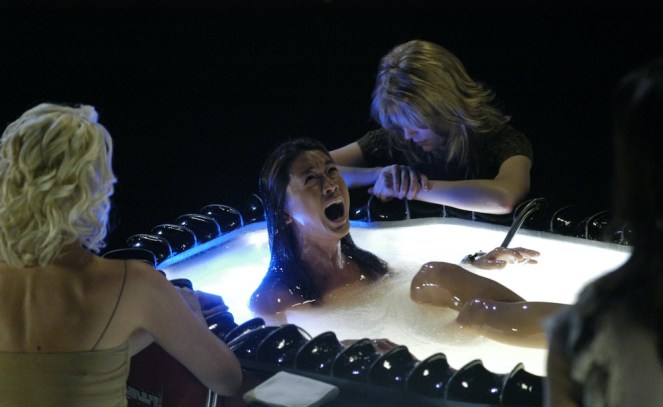
Most of the Cylons are identified by their model number but some use a name so they can pass themselves off as human while remaining true to their programming. Others have been placed into the human fleet without awareness of their true nature, such as Sharon Valerii, who is a Number Eight model.
On Galactica, Sharon is called Boomer (her viper pilot callsign), and she’s blissfully unaware that she’s a Cylon. She realises something is wrong when she’s compelled to sabotage a mission to find a source of water but manages to override her programming. She doesn’t want to hurt anyone. However, she finally loses the battle and shoots Adama in a shocking twist at the end of season 1.
Meanwhile on the planet Caprica, another version of Sharon (who later becomes known as Athena), is helping human Karl Agathon (Helo) to survive. She’s fully aware of her Cylon nature and has a mission to seduce Helo and get him to fall in love with her so she can get pregnant with a human-Cylon hybrid baby – a central part of the Cylon plan.
Much of the drama centres around the question of whether the Cylons are alive or just machines – similar to Blade Runner. The first line in the mini-series poses the question:
“Are you alive?”
And then the challenge to prove it. How do you prove that you’re alive or that you’re sentient?
The humans tend to dismiss Cylon emotions and thought as programming. They call them toasters or skinjobs and don’t think twice about torturing them for information or just for fun. On Caprica, Sharon gently suggests to Helo that if cloned human beings have emotions, that means they could be misled or make mistakes, just like humans. But Helo rejects this, saying they’re just machines.
Over time, attitudes change as events show that humans and Cylons aren’t so different from each other. But trust is hard to maintain. Adama comes to accept that Boomer isn’t just a machine that shot him, she’s a person. She was on the ship for two years and integrated into the crew, and he says a machine couldn’t do that. Although later he refers to a different version of Sharon as a thing, so perhaps that lesson hadn’t quite sunk in yet.
Helo also changes his attitude and becomes a champion and protector of Cylon rights, especially once his hybrid daughter Hera is born. The common ground between the humans and Cylons is that they both want to live and survive. And in season 3, Gaius Baltar says:
“Cylons, humans. We’re all just trying to discover who we are.”
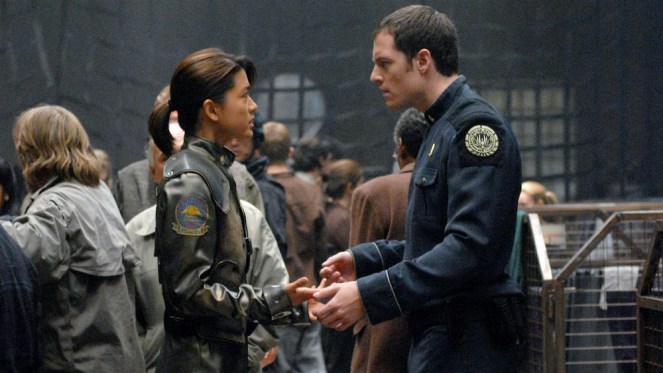
It may seem that hatred of the Cylons is justified – they are trying to wipe out the human race – but that hatred goes both ways. The Cylons are determined to destroy humanity and a Number Five justifies this by saying that humans would’ve destroyed themselves anyway, and that:
“They deserve what they got.”
They have a lot of resentment towards the humans and hatred of their creators. The source of this hatred appears to come from John Cavil, a Number One, who hates humanity and resents the fact that he was created in human form by the Final Five. He’s also an atheist and wants justice for the Centurion side of his family who were the slaves of humanity – hence the attack on the Colonies.
In episode 15 of season 4 (No Exit), Cavil has a spectacular rant about the limitations of the human body. He complains of being unable to participate fully in the experience of seeing a supernova, saying:
“…you know how I perceived one of the most glorious events in the universe? With these ridiculous gelatinous orbs in my skull. With eyes designed to perceive only a tiny fraction of the EM spectrum. With ears designed only to hear vibrations in the air.”
He shouts that he doesn’t want to be human! He wants to see gamma rays and hear X-rays, but he can’t because he’s trapped:
“Do you see the absurdity of what I am? I can’t even express these things properly because I have to conceptualise complex ideas in this stupid limiting spoken language. But I know I want to reach out with something other than these prehensile paws and feel the solar wind of a supernova flowing over me. I’m a machine…I could experience so much more, but I’m trapped in this absurd body. And why? Because my five creators thought that God wanted it that way.”
He’s feeling a bit gnostic. The cure for that is to become a mystic but he’d have to give up his attachment to his belief in rationality and materialism – but I’m getting ahead of myself. The point is, the genocide of humanity rests on a foundation of jealousy and rage and an inability to love. As Ellen Tigh (one of the 5) points out, he’s not limited:
“We gave you something wonderful. Free will. The ability to think creatively, to reach out to others with compassion. To love.”
Cavil blames her for his faults and failures because she made him. But of course, he has free will so he has a choice in how to perceive reality. And he chooses to be a miserable materialist, calling the rest of the Cylons “delusional machines” – which begs the question: Can a machine be delusional?
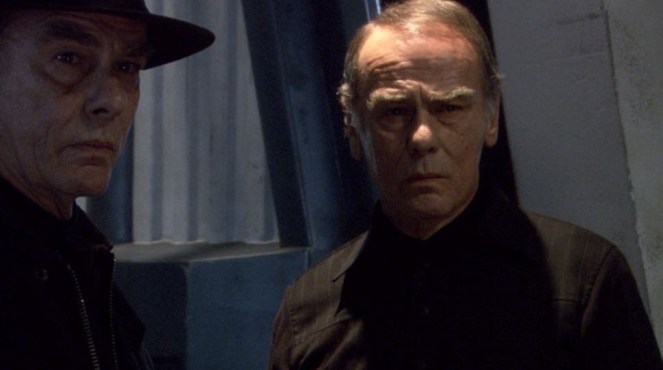
There’s another version of Cavil who seems to have some sympathy with humans which shows that he can change his programming. He’s free to choose to see things differently, just as humans are free to change their minds and overcome their conditioning.
Freedom to think for yourself and to choose is central to being human but we often end up behaving like robots. We sleepwalk through our days on autopilot, running unconscious scripts that act like programming. Childhood conditioning can make us behave in ways that go against our own best interests and yet we still struggle to free ourselves and wake up.
Some of the unconscious patterns we get into are useful, but even those can become destructive in the wrong context. For example, BSG shows how the military chain of command works with everyone following orders without question. This is a form of programming and can look robotic but it allows teams to work efficiently under stressful conditions. But it has a downside too.
In episode 8 of season 2 (Final Cut), a film is made about life onboard Galactica in order to humanise the military for the rest of the fleet. Some of the personnel talk about how the training tries to turn off the human part of you so that you’re not afraid to die. It means you can act without thinking, but some can’t take the pressure and it pushes them over the edge.
This dehumanisation makes it easier to hate and destroy the enemy, but it also turns people against each other. It destroys trust, making people paranoid and suspicious which causes society to break down. In BSG, the humans fight each other as well as the Cylons, and then the Cylons start to fight amongst themselves too.
Cylon unity breaks down because some of the models become more individualised and choose to go against their programming. The other models are inspired by the experiences of Sharon (Number Eight) and Caprica Six who have lived with the humans and learned to love them.
This is dangerous for the other Cylons because Sharon and Caprica Six are now seen as heroes and are admired for their sacrifices. They’ve become celebrities in a culture based on unity and have developed a different perspective based on their love of human beings. After using Gaius Baltar to get access to the defence mainframe, Caprica Six now realises that they made a mistake in killing the humans, saying:
“Genocide, murder, vengeance – they’re all sins in the eyes of God.”
Sharon agrees and says the other Cylons don’t want to hear that because then they’d have to rethink what they’re doing. Caprica Six believes they can change for the better and says:
“Our people need a new beginning, a new way to live in God’s love without hate, without all the lies.”
Sharon and Caprica Six finally realise that they’re alive – it’s like an awakening – they feel alive and free because they’ve chosen to think for themselves.

Another shift in Cylon perception happens when they find themselves beyond the reach of a Resurrection ship, making them mortal. Death makes them more conscious and awake to the meaning of life and they start to question what they’ve been doing. They start to value the lives of the humans more. A Number Six explains that when their people started dying things began to change:
“We could feel a sense of time, as if each moment held its own significance. We began to realise that for our existence to hold any value, it must end. To live meaningful lives, we must die and not return. The one human flaw that you spend your lifetimes distressing over – mortality – is the one thing…that makes you whole.”
When the Resurrection ship is finally destroyed, there’s no difference between the Cylons and humans – apart from their technology and their beliefs in God. In the next post, we’ll delve deeper into the religious aspects of Battlestar Galactica…
Explore more films here
Thanks for reading! If you’d like to support my work, please donate below 🍵. Thanks in advance! 🙏❤️

 Jessica Davidson
Wow! I really appreciate your ‘dive’ into this complex series. So many themes expertly interwoven over the years of its airing. I watched it all. Much to contemplate!
LikeLiked by 2 people