
In the first part of this series we explored the technology of Battlestar Galactica and how it relates to our humanity vs machines. In this part we delve into the religious beliefs of the humans and Cylons in the mini-series and main seasons, including a peak at the prequel Caprica – and as always, Expect SPOILERS!

Battlestar Galactica (BSG) is bursting at the seams with religious symbolism so this post will barely scratch the surface. There are many elements of the story that are similar to events and parables in the Bible. The above marketing image is one rather on the nose example of the cast doing the Last Supper which doesn’t relate to anything in the show – unless you count Gaius Baltar as a Jesus or saviour character.
The overall structure of the story of BSG is similar to that of Exodus which recounts the tale of the Jews leaving Egypt led by Moses and wandering in the wilderness in search of the promised land. In BSG the humans are exiled and wander in the desert of space looking for a new home, the promised land of Earth. On the journey they go through a death-rebirth process and experience a loss of faith followed by renewal and a new beginning after many trials.
However, the religion followed by the humans is nothing like Judaism or Christianity, and the show does something much more interesting. The humans are polytheistic in their beliefs, while the Cylons are monotheists who believe in God. This creates plenty of tension and opportunities for theological discussions in between all the running around and killing each other.
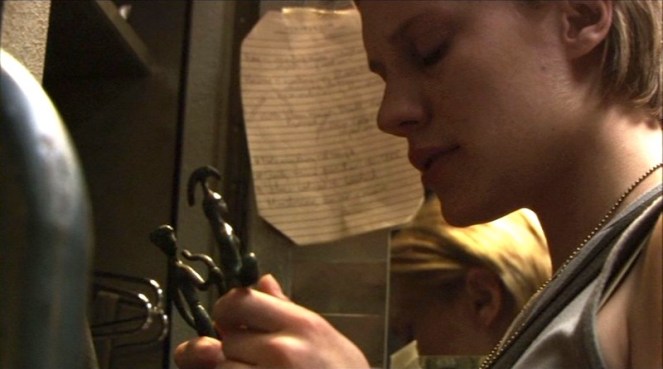
The humans believe in the Lords of Kobol who are based on the 12 Olympians of the Greek and Roman pantheons, such as Zeus, Ares, Athena, and so on. They pray to the gods in temples but some also have figurines that they use to pray for help or guidance. The phrase “So say we all” is said at the end of prayers in place of “Amen” and is used to bring people together and raise morale.
The planet Kobol was the birthplace of humanity where they lived alongside the gods in 12 tribes, like the 12 tribes of Israel. The name ‘Kobol’ is a reference to a star called Kolob that comes from the Mormon beliefs of Glen A Larson, the creator of the original TV series in the 1970s. According to Mormonism, Kolob was the star nearest to God.
At the start of the series, the humans live on the Twelve Colonies of Kobol which are planets named after the original tribes, such as Caprica, Tauron, Gemenon, Picon – and the rest of the signs of the zodiac. The original home world of Kobol is now deserted, although it is mentioned in the sacred scriptures.
The sacred scrolls of the Lords of Kobol were written thousands of years before the events of the series. One of the writers was called Pythia, an ancient oracle whose words guide the humans on their journey through space. In ancient Greek history, Pythia was an oracle at the temple of Delphi dedicated to the god Apollo and known for prophesying in riddles that were hard to interpret. However, the scriptures in BSG are much easier to understand.

Laura Roslin plays the role of Moses, leading her people across the desert to find the promised land. She starts out as sceptical but is transformed into a prophet and true believer, only to lose her faith again before finding peace. Roslin becomes President after the Cylons attack the Colonies because she’s the only member of the government left alive. She has also just been diagnosed with cancer.
To begin with, Roslin doesn’t believe in the scriptures which mention a 13th tribe that left Kobol and went to Earth in a distant and unknown star system. When William Adama announces that he knows the location of the thirteenth colony, she tells him it’s bullshit. He agrees that it’s just a legend but they need something to believe in and give them hope – let it be Earth.
But then Roslin starts having hallucinations induced by the drug she’s taking for her cancer treatment. The drug is called Chamalla and it’s used by priests and oracles to speak to the gods and receive visions. During a press conference Roslin sees twelve snakes slithering over the lectern, so she goes to see the priestess, Elosha, who says:
“3600 years ago, Pythia wrote about the exile and the rebirth of the human race. And the Lords anointed a leader to guide the caravan of the heavens to their new homeland. And unto the leader they gave a vision of serpents, numbering two and ten as a sign of things to come.”
Elosha doesn’t know that Roslin has cancer and goes on to say that Pythia also wrote that the new leader would suffer:
“a wasting disease and would not live to enter the new land.”
These visions turn Roslin into a believer and she sends Starbuck back to Caprica to retrieve the Arrow of Apollo because the scriptures say that this ancient artifact will point the way to Earth. To use it they have to return to Kobol and find the Temple of Athena which will give them directions.
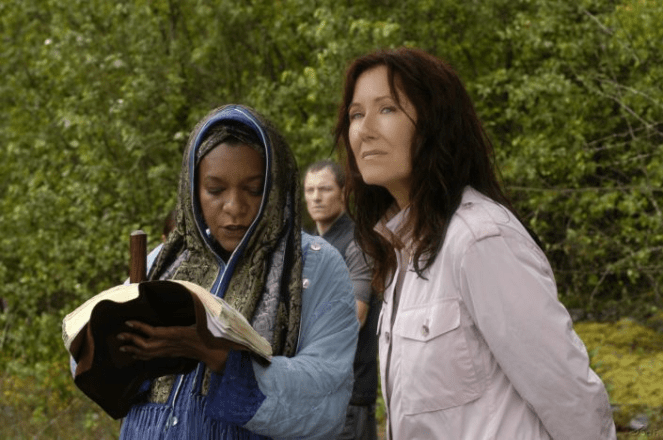
Interestingly, while on Kobol, Gaius Baltar discovers piles of human skulls lying around the ruins of the temple. His Angel Six (details below) tells him that Kobol is cursed because of the human sacrifice that took place there as part of their religion. She says that anyone who dies on Kobol won’t receive eternal life and that:
“God has turned his back on Kobol, turned his back on man and the false gods he worshipped. What happens on Kobol is not his will.”
So at this point, humanity has wandered a long way from God on their exodus. And worse is to come when they finally arrive at Earth to find an apocalyptic landscape of death. Earth has been destroyed and the gods have led them into hell. Roslin loses her faith in the Lords of Kobol and burns the scriptures.
While some can’t handle the crushing disillusionment and loss of hope, Lee Adama says they’re now free to go where they want to go and be who they want to be. They’re not bound by the “ramblings of Pythia” anymore.
Later, as Roslin is close to dying, she’s terrified of what comes next. Her fragile belief in the gods isn’t enough to comfort her because she sees them now as metaphors. Another patient encourages her to believe in the One God of the Cylons, but she can’t accept that either. In a vision, she sees Elosha who says that Roslin has walled herself off from people and doesn’t love humanity. To find peace she needs to love someone.
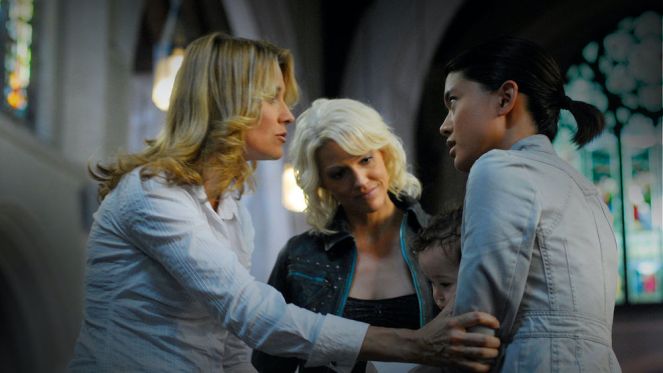
In contrast to the humans, the Cylons are monotheists who believe in the One God or One True God. Like humans, some Cylons are believers and some are atheists, like John Cavil who we met in part 1, but they all tend towards fundamentalism and zealotry. They want to wipe out the human race and their false gods.
This has some similarities to the rise of Christianity and how it clashed with the pagan beliefs of Rome and elsewhere. In many places, Christianity did replace the old beliefs but it also survived by incorporating elements of paganism into itself as it spread. In BSG someone mentions that the Cylon God shares similarities to their Mithras – just like Christianity does. However, the Cylon God isn’t the God of Christianity and the belief system appears to be cobbled together from various sources and includes concepts like reincarnation.
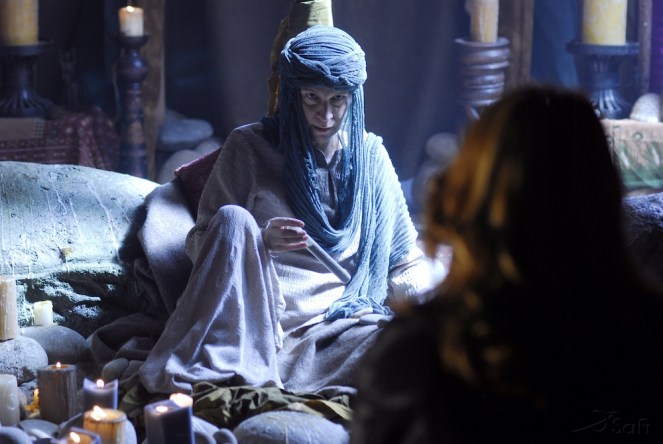
There also appears to be a connection between the Lords of Kobol of the humans and the One God of the Cylons. The human scriptures mention a “god whose name must not be spoken”, like Yahweh (or the God formally known as Yahweh). And when D’Anna (Number Three) has prophetic dreams, she visits a human oracle who has a message from “the one you worship”, saying:
“He speaks through me to you just as he speaks in your dreams.”
It seems strange to think of a robot believing in God – where did it get the idea from? To find out we have to turn to Caprica, the prequel to Battlestar Galactica, which is set 58 years before the attack on the Colonies.
The prototype Centurions were built by Daniel Greystone and their consciousness came from a sentient digital avatar of his daughter Zoe who was killed in a terrorist attack by religious fanatics. Zoe had created the avatar as a kind of self-aware digital soul, a copy of herself who felt everything she felt, including her religious beliefs. (This requires a major suspension of disbelief!)
The avatar ‘lived’ in a virtual reality world full of teenagers doing crazy things like drinking, having sex with strangers, and killing each other in human sacrifices. Zoe and her friends didn’t like this and had found a new religion which they felt gave their lives more meaning and a sense of morality. The cult was called Soldiers of the One and they believed in the One True God, who unlike the Lords of Kobol, actually answered your prayers. As Zoe says:
“There is truth in the world…There is a right and a wrong. And there is a God. A God who knows the difference.”
Greystone was distraught by grief over the loss of his daughter and wanted to defeat death to bring her back. But he didn’t know that Zoe believed in the One True God when he loaded her avatar into the first Centurion. This is the source of the monotheist belief of the Cylons, but as Baltar says:
“Man may have made [the Cylons], but God’s at the beginning of the string, isn’t he? It’s God who made them with a soul. The One True God.”

The Cylons have their own equivalent of Pythia and her obscure prophecies in the form of the Hybrid – basically a woman in a bath who is plugged into the Cylon baseship, reminiscent of the precogs in Minority Report. The Hybrids were created during the evolution from Centurions into humanoid Cylons via barbaric experiments using human beings – it’s a bit grim.
The Hybrid controls the ship and the faster-than-light jumps through space and is aware of everything that happens on board but also apparently elsewhere too. She talks constantly, blurting out technical details mixed in with bits of poetry and gibberish. Most of the Cylons think that the conscious mind of the Hybrid has gone mad and what she says is meaningless. But Leoben (Number Two) hangs on her every word and believes that God speaks through her, like an oracle.
Leoben believes that he has spiritual clarity because he can see the patterns in the universe that tell him what God wants. He likes to talk theology and metaphysics and often says things that sound a bit Buddhist, like:
“What is the most basic article of faith? This is not all that we are…I know that I’m more than this body, more than this consciousness. A part of me swims in the stream but in truth, I’m standing on the shore. The current never takes me downstream.”
But this clarity comes from the Hybrid which isn’t clear at all and must be interpreted. This gives the Cylons plenty of wiggle room to justify whatever they want to do and call it the will of God. They see themselves as perfect (which they aren’t) and chosen by God because the humans are flawed creations and don’t deserve to live.
Not all the Cylons hate humans this much and their attitudes change as events unfold, as we saw in part 1. But there’s one Cylon in particular who takes a close interest in the transformation of one human being. Number Six is on a mission to bring her faith to humanity and she’s determined to do this by saving Gaius Baltar’s soul.
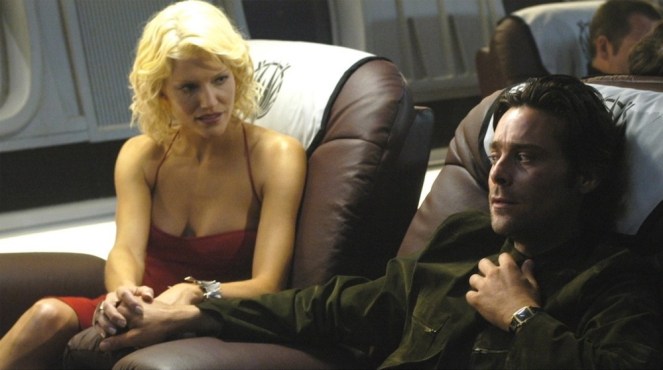
Gaius Baltar goes through a similar transformation to Roslin. He starts out atheist and self-involved, and slowly gets in touch with his humanity and learns to care for others rather than himself. It’s a hell of a journey and he’s humbled and almost broken by the process. He really has to work for his salvation, confront his failings and earn grace, showing that no one is so sinful that they can’t be saved and that humanity deserves a second chance.
Baltar is a scientist and sceptical of all religious beliefs, a genius but arrogant, a hedonist and womaniser, self-indulgent and narcissistic. When he discovers that he’s responsible for the Cylon attack on the Colonies because he gave the access codes to Number Six, he’s more worried about his reputation than the fate of humanity.
Number Six (who becomes Caprica Six) seduced Baltar to get the codes but also seems fascinated by his ego and amazing capacity for self-deception. She says she fell in love with him because:
“You have a clarity of spirit. You’re not burdened by conscience or guilt or regret.”
He’s a hopeless sinner and ripe for saving. She tells him that God doesn’t take sides and only wants your love:
“Open your heart to him, and he’ll show you the way.”
But to do this you have to be humble and surrender your ego – something that Baltar isn’t very good at. He gets lots of opportunities to practice and mostly fails and loses everything, including his reputation. He ends up having a religious conversion to the One True God and becomes the leader of his own cult, which just feeds his ego even more.
Baltar tells his cult members that he’s not a priest but a profoundly selfish man. But that doesn’t matter because:
“something in the universe loves me…I will choose to call this something God. A singular spark that dwells in the soul of every living being. If you look inside yourself, you will find this spark too.”
He tells them to look deep and to love their faults and embrace them, saying if God embraces them, how can they be faults? He goes on:
“The truth is, we are all perfect just as we are. God only loves that which is perfect, and He loves you.”
There are some basic rookie mistakes here. God doesn’t love only that which is perfect, he loves everything regardless. And we aren’t perfect – only God is perfect. Accepting your faults and loving them doesn’t mean they’re not faults and therefore good – that’s false logic. It’s an egotistical narcissist version of religion that justifies doing whatever you want in the name of love – very New Age.
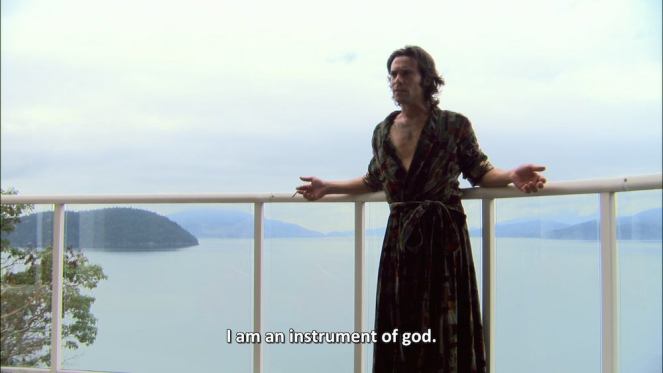
Baltar continues to make excuses for his previous actions, saying that God has washed away his guilt. He confesses to Roslin:
“Truth is, I was harbouring the most awful, desperate guilt. A heavy, dark unimaginable soul-breaking guilt. Now it’s gone…I have been transformed.”
He says he was saved the moment he confronted his guilt over the genocide of humanity and believes he was rewarded. He compares what happened with a previous flood that wiped out most of humanity:
“Nobody blames the flood. A flood is a force of nature. Through the flood, mankind is rejuvenated, born again. I was another flood, you see.”
He blamed himself but then lets himself off the hook by using God as the excuse in the same way that John Cavil blamed his makers for his actions. Baltar says:
“…God made the man that made that choice. God made us all perfect. And in that thought, all my guilt flies away like a bird.”
Now, there is a level on which this is true. If God is everything and is the only Being who truly acts, then it’s all good, as they say. This is the argument that Arjuna has with Krishna in the Bhagavad Gita because he doesn’t want to kill on the battlefield. Krishna tells him he must do his duty as a warrior and act in faith and fight without desire or attachment.
But only a saint could make this argument because only a saint can act without karma and let God act through them. Baltar is no saint and is just avoiding real remorse for his actions. You can excuse anything using this argument and justify any amount of barbarity by presuming to know the mind of God.
Baltar’s faith is finally tested when they find the promised land of Earth has been destroyed. Like Job in the Bible, he rages at God for his betrayal. What have they done to deserve this punishment? To be condemned to wander the universe without hope? What kind of father abandons his own children to despair and loneliness?
“Perhaps it is God who should come down here and beg for our forgiveness!”
Then when it really counts, Lee Adama challenges Baltar to do one thing that’s truly selfless. And he finally does, by rescuing the child Hera from the Cylons and thus saving the future of humanity. He also manages to persuade John Cavil to back down and give up the fight in the human-Cylon war. Baltar acknowledges the mystery at work in the universe and that he doesn’t understand it, and says:
“God’s not on any one side. God’s a force of nature beyond good and evil. Good and evil, we created those…You want to break the cycle of birth, death, rebirth, destruction, escape, death. Well, that’s in our hands and our hands only. It requires a leap of faith. Requires that we live in hope, not fear.”
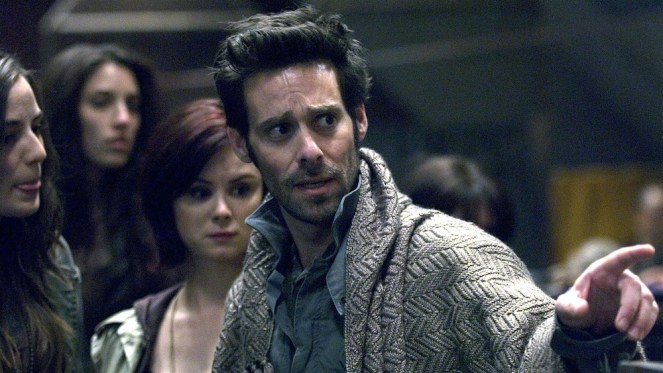
All the way through, Baltar is encouraged and cajoled by his Angel Six who pushes him to do and say things, to gain power or make certain moves – apparently to bring him to the point where he’s in the right place at the right time to save Hera. Only Baltar can see this Number Six and their interactions are a great source of comic relief throughout the series. (She’s also referred to as Head Six and Messenger Six but I prefer Angel Six.)
At first, Baltar thinks she’s a manifestation of his own subconscious and then wonders whether he has a chip in his head or is going mad. Finally she explains:
“I’m an angel of God sent here to protect you, to guide you, to love you.”
Other characters also have their own messengers or angels who appear as someone close to them. Caprica Six has an Angel Baltar who performs the same function as Angel Six for Gaius, and then Baltar sees him too (a fun moment). Roslin’s vision of Elosha was a visitation from her Angel, and Starbuck receives two visits, one from her father and another from Leoben – but Starbuck is a special case which we’ll look at next time (cos this post is already too long!).
Finally, we have the theme music for the show which features a version of the Gayatri Mantra from the Rig Veda. This is a hymn dedicated to Savitr, god of the sunrays who protects all beings and represents consciousness and enlightenment. The words can be translated in various ways but it’s a mantra to bring wisdom and awakening. This version comes from The Plan which is slightly longer than the one used in the main seasons but it’s the same in essence. Enjoy!
In the final post, we’ll delve further into the nature of the gods and the cyclical view of history in Battlestar Galactica…
Explore more films here
Thanks for reading! If you’d like to support my work, please donate below 🍵. Thanks in advance! 🙏❤️

 Jessica Davidson
Awesome! So, much to ponder and grok in that series, for Humanity’s (the real one) story in myth and archetype, played with, so ironically, tragically, and with some humour too. Thank you! I know lots more could be said.
LikeLiked by 1 person