
We’ve been exploring the current mini triangle alignment between Uranus, Neptune and Pluto which represents a key turning point in the history of civilisation. In this post, I’d like to share my notes on an article by Gerry Goddard which explores how ‘Western’ culture and consciousness evolved in relation to the discovery of these planets and the challenge they represent. It was written in 2001 and updated in 2003 so things have unravelled a lot since then but it’s still worth reading and contemplating for inspiration on how to deal with these energies.

As we saw in the previous post, each of the transpersonal or trans-Saturnian planets were discovered in a particular century. Uranus was discovered in the 18th century (1781), Neptune in the 19th century (1846), and Pluto in the 20th century (1930). He says these discoveries gave those centuries their particular characteristics: the 18th century was Uranian, the 19th century was Neptunian, and the 20th century was Plutonian.
So the 18th century was more intellectual and abstract than the romantic and emotional 19th century. Uranus was the prophet of individualism and the ideal of freedom for the individual, while Neptune revealed our tendency to get swept up in collective movements that dissolve the individual, as well as our love of utopian visions that offer redemption.
The romanticism of Neptune can be seen as balancing the rationalism of Uranus as it values imagination and feelings over cold abstraction. Uranus objectifies and abstracts reality while Neptune calls for a leap of faith. Uranus looks for truth by distancing itself from reality, while Neptune dissolves and blends into reality and knows it from within, a more direct experience of mystical participation.
In the 18th century we believed we could know reality by abstracting and codifying it, but then realised it was more complicated than that. Thanks to Neptune, we realised that our minds were part of the reality we were trying to understand and that we couldn’t separate ourselves from it. So Neptunian faith balanced Uranian abstract vision but also undermined it.
By the time we discovered Pluto we were in a more advanced stage of technological development but still driven by irrational emotional energies and assumptions about reality. So Pluto’s early manifestations have been highly destructive – nuclear power and fascism (i.e. corporate power) being the obvious two examples, as well as economic collapse.
Pluto represents mass consciousness on an instinctual level, driven by the desire for power and control. It has given rise to mass culture that exploits our lower drives, instincts and fears at the same time as repressing them and causing neurosis and other distortions.
Meanwhile, the philosophy of materialism led to the development of scientism and positivism which deny transcendent realities by focusing on empirical and reductive reasoning. Alternative perspectives are then pushed into the unconscious from where they wreak havoc.
We really needed to integrate the approaches of Uranus and Neptune with Pluto but instead our conception of reality was undermined. So far, we’ve failed to understand the meaning of Pluto and how to work with his energy consciously, as he explains:
“In the Plutonian global crucible, neither a mass meltdown, a totalising grand narrative (be it science, capitalism, or a new world religion), nor the hegemony of any one part over the whole to which it belongs are creative evolutionary options. Pluto symbolises an absolute, concrete and foundational crisis; above all, an imminent threat of global environmental devastation requiring nothing less than a total and integrated intelligence in action.”
The problem is each of these planets has ‘higher’ and ‘lower’ expressions so the way they manifest is complex. The Uranian experience leans towards the individual while Neptune leans towards the collective. Both transform the individual and society but how that transformation happens depends on how we engage with it and it often stays at the level of the mind and culture.
“To the degree that Uranus, in association with Saturn, brought ‘real’ and concrete changes along with the significant developmental mental/cultural shifts, it tended to amplify and reinforce the hegemony of techno-instrumental reason; precisely the growth of industrial capitalism through the 19th century.”
We can see Neptune’s relationship to Uranus/Saturn as the spread of new technologies that encourage a more ‘right-brained’ way of thinking, less critical and discursive and more imaginative. We can see this in the development of mass communication and mass media. People now read less than before and even text-based communication has become infused with emojis.
He also mentions a relational schism that developed between Neptune and Uranus/Saturn in the 19th century when religious and humanistic values were seen to oppose materialist science and technological progress. The split between religion and science, or belief and non-belief, linked the belief in science to the belief in progress and the belief in religion with superstition and the past.
By the end of the 19th century people had given their power over to forces and systems beyond themselves – not to transcendent realities or God or the Church but to material forces: market forces, economics and technology. This was a failure of Uranian vision to truly transform the old structures of society rooted in material and practical fears – i.e. pragmatism.
So we ended up with a split between the romantic worldview of Neptune and the scientific worldview of Uranus. Neither are totally correct on their own. They need each other.
“Neptune had not only to be expunged of its religious elements, but also of its idealist and transcendentalist dimensions – they were explored (though inadequately) and would be found wanting in the next and Plutonian stage. No synthesis of Uranus and Neptune is possible without Pluto; death, human evil, psychopathology, all had to be integrated into a world view or a way of being.”
This process involved the development of a new philosophical movement: existentialism, which addressed ultimate concerns. But this failed too because it also split into two paths: rational materialist vs spiritual/transcendent versions.
“The Uranian world of the Enlightenment was a vision of a universal order – the good, the true and the just. It was a vision of the way the world should be for everyone, where an informed and benevolent goodness would prevail. But then Neptune soon opened up a much larger field of reality; the abstract universal had become ‘real’ but in a way that eluded the power of rational individual control revealing the limitation, naivete and even the negative shadow of such a ‘logocentric’ and theoretical world.”
Before Neptune’s discovery, romanticism was more Uranian and believed in the ‘goodness of nature’ and in human progress. But this had to be undermined and challenged because it was too naïve.
Neptune revealed there was no solid ground on which to stand, no way to really know what objective reality was because everything was relative and could be seen from multiple perspectives. This led to the destruction of the 20th century and the arrival of the Plutonian dimension. Our grasp on reality started to become tenuous and we were taken over by our own imaginations. Everything we previously took for granted was deconstructed, including morals and the idea of good vs bad:
“Reason becomes caught in a web of the irrational, a veil, a maya. But beneath this phenomenal realm of appearance lies a core of things, a noumenal, yet unconscious, amoral and irrational will.”
The Plutonian archetype manifested in its darkest form, totally unbalanced, a will to power to compensate for the loss of certainty everywhere else. There is no ground to stand on so I can only assert my will.
“The genuine aims of the Enlightenment – truth, justice, democratic participation – called for the ongoing development of individual critical rational autonomy and inter-subjective dialogue free from institutional restraint. But such an aim, such a value, has been increasingly undermined by industrial capitalism and the increasing hegemony of technological elites as well as increasing intellectual and cultural confusion through the ‘Age of Neptune’.”
Now we need to deal with our unbalanced relationship to Pluto in order to heal this situation and find a way forward that isn’t destructive and doesn’t throw out the positive benefits of Uranus and Neptune. We need to keep the rational critique of Uranus and the universal compassion and connectedness of Neptune in order to uncover and reveal the patterns of power that have distorted our relationship to each other and reality.
That means doing shadow work and facing the naivete of our past romantic notions about what was possible, what human beings are capable of doing and how we can live together without falling into the usual patterns. It also involves facing the reality of the oppressive Plutonian structures that we live within:
“The majority in the 19th century and the first half of the 20th century knew that they were oppressed and correctly knew, to some extent, who were their oppressors. … Yet post-war developments in liberal democracy bringing a lessening of repression and an increase in the sharing of wealth…lulled the population into thinking that they were truly living in a ‘democracy’ where the individual mattered and had true rights and participatory power.”
The difficulty then is that the oppression is hidden or obscured because it’s such a pervasive part of the system itself and it works largely through the unconscious. It’s easy to identify individuals who abuse power but it’s harder for people to join the dots and see the nature of the system that they live inside – like a fish swimming in water and not knowing what water is.
We believe we’re free but we’re not. We have no idea how our thinking has been shaped by forces beyond our control that don’t have our best interests at heart. We’re hypnotised, under a spell of Neptunian propaganda. This only works if you haven’t learned to use Uranus effectively – i.e. critical thinking and an understanding of the importance of individual autonomy and freedom:
“In fact, even if not deliberately, Neptune in the hands of techno-capitalism keeps people away from the opportunity of Uranian cultural education – an education free from a shaping by corporate interests and free to be critical of those interests.”
Mass media is Neptunian but its control by corporations is Plutonian. Breaking through this isn’t easy:
“Mass culture is precisely the barrier that represses or shields the individual from having to face the inner Plutonian angst and alienation. To expose the propaganda behind the media in our age (as well as exposing the nature and effects of the media) exposes individuals to facing their inner pain and depression.”
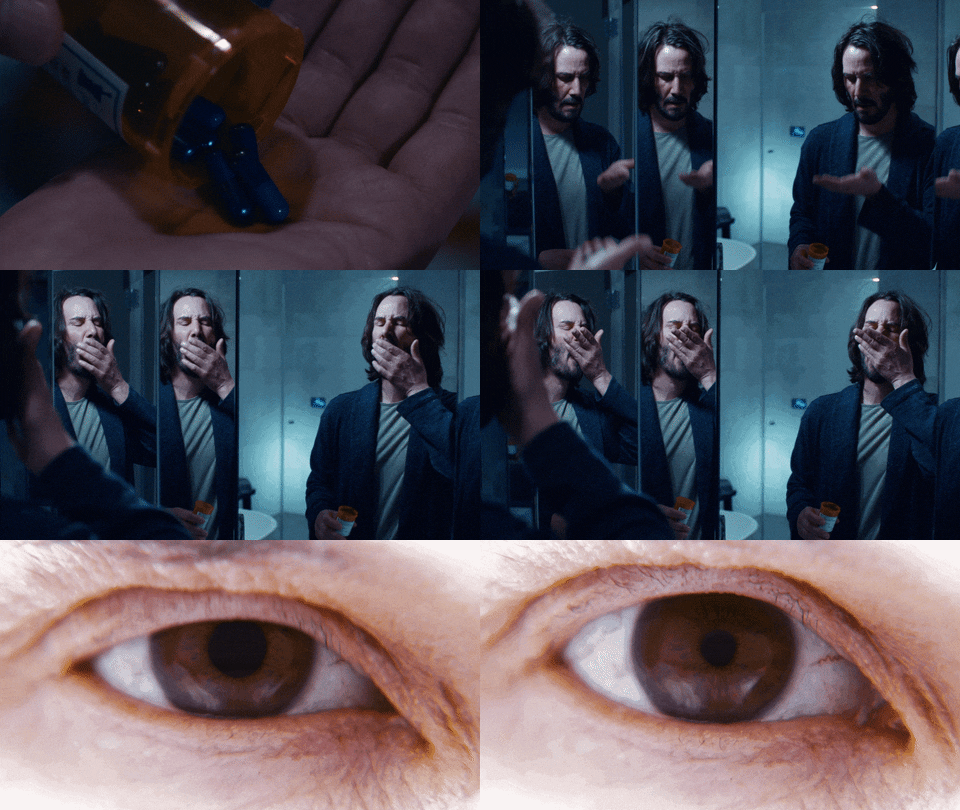
This is why it’s so hard to wake people up. They don’t want to see reality. They want to live in a fantasy world created for them by the system that’s busy destroying them. Mass ‘culture’ is used as a drug to keep people asleep – like Neo in the latest Matrix movie taking a blue pill prescribed by his psychiatrist. We’re all half mad and desperately pretending that everything is fine!
To counter this, we need many more people to wake up and begin thinking for themselves (Uranus). But that also means facing the darkness and traumas hidden in the depths of your own being (Pluto). Pluto encourages you to penetrate the depths, to find the foundation of your being but what you find down there is Neptune:
“Such relentless Plutonian explorations and excavations have revealed, in contrast to the Saturn/Uranus and Jupiter/Uranus rational and humanistic order of the Enlightenment, a Neptunian indeterminate, elusive, insubstantial void or chaos in both nature and psyche. Interestingly, this Neptunian insight is an answer to the Cartesian split which still dogs our mainstream culture: the foundations turn out to be both interior and exterior at the same time!”
This is easy for a mystic to understand and accept. Unfortunately, ‘Western’ civilisation rejected the transcendent perspective:
“In its hyper-rational yet paradoxically, in its irrationally dogmatic resistance to any suggestion of transcendental principles, our age condemns itself to an endless insanity of tightening inward spirals of self-reference, a solipsism of the collective.”
In other words, the West has lost its mind. Reason has become unreason in “a sick and perverted form of marginalised Romanticism and Idealism.” He calls this a Plutonian crisis of values:
“The most pressing issue becomes that of birthing a new engaged ethics in a terrifyingly Darwinian noosphere where the overriding value is an amoral pragmatism.”
This probably won’t end well. Unless individuals take on the challenge of becoming more conscious and engaged in their own evolution.
“Like never before, the autonomous and responsible individual is the agent of further evolution. Individuals and the collective must evolve this resonant interiority before transpersonal levels can be reached in a natural way. To fail to do this results in a regressive devolution.”
And:
“The failure to incorporate the Uranus, Neptune and Pluto archetypal forces into a developing and maturing individual psyche and a self-enlightening culture is ultimately catastrophic.”
So we must find a way to transform ourselves and complete our individuation:
“From a relatively mature left/right brained Uranian/Neptunian selfhood – intellectually informed and critically aware; intuitively and heartfully open – the depths of the Plutonian shadow can be accessed and faced, ultimately leading toward deep transformation. We must ‘take back’ the projections of darkness and attune to the subtleties of interpersonal power dynamics…the whole gamut of entrenched emotional complexes, the transformation of which is the concern of the deeper approaches of humanistic psychology…and body work.”
Perhaps the current mini triangle alignment between Uranus, Neptune and Pluto will encourage more people to engage with this process. But all three planets must be integrated and made as conscious as possible so they can be balanced with each other in the transpersonal realms.
For more ideas on how this can be done, I encourage you to read the full article by Gerry Goddard. It’s long but worth taking the time over: Uranus, Neptune, Pluto: Our Contemporary Evolutionary Challenge
Read all the mini triangle posts here
Thanks for reading! If you enjoy this blog and would like to support my work, please donate below 🍵. Thanks in advance! 🙏❤️

 Jessica Davidson
I love your informative, useful and straight forward articles and I feel I really resonate with them. I would love to hear more about the up and coming conjunction of Saturn and Neptune especially as it’s going to oppose my natal Saturn conj Neptune in Libra and what with dealing with Uranus and Jupiter transiting my first house for a while now I’m feeling a bit unmoored to say the least 😏
LikeLiked by 2 people
I might write some more about the Saturn Neptune conjunction next year when it starts getting closer together. In the meantime, there’s this: https://jessicadavidson.co.uk/2021/08/23/the-saturn-neptune-cycle-and-the-dream-of-reality/
LikeLike
Great article Jessica, thankyou.
My intuitive sense tells me that unless unconscious people rediscover and claim their spirituality, they will never wake up. The material world is all but an illusion, designed to make us believe that’s all there is. Higher consciousness tells us we are here to evolve, to participate in life in ways that transcend our physical being. What we do not complete in this life, we get another chance to finish in the next. For those who are completely clueless, well they just get more “Groundhog Day”, until they do wake up and work it out. Spirit never dies.
LikeLiked by 1 person
are you still alive?
LikeLike
are you?
LikeLike
I wonder if the lesson isn’t in individuals taking ‘personal responsibility’ so much as collecting as groups, communities (in our workplaces, book clubs, forums, wherever we already collect) and being responsible for both ourselves as well as to each other as members of groups/communities. To do this with interdependence and not codependence. I think this because I see the individual vs the state (or corporate power or all overt or even the subtle, insidious top-down dynamics of interpersonal relationships where it may be individual vs the other) is a sort of paradigm that leaves out something we have all but stopped thinking of ourselves as a part of – community. Despite participation in groups for sport, church, whathaveyou, the nuclear family of western culture in particular, curated out of the protestant ethic and the spirit of capitalism and cementing how we ‘perform’ gender, family, even ‘home’ – it separates us from each other, from ‘what we owe to each other’.
We communicate with communities more than ever but its mitigated and policed by algorithms the average person doesn’t understand to the point that we can’t self-regulate the dopamine hits of likes and replies because it is indeed like a drug.
So. How do addicts and abuse victims and abusers even recover? How do you get from abuse of power and powerlessness to healthy boundaries? What actually ‘works’ is the hard work involved in community intervention and support, where reflexive, consistent, tough but fair love and, most importantly, humility and self-reflection are prioritised.
To that end, I wonder, should a transit make for a powerful kite formation, what body/bodies would offer an opposition to total dissolution of neptune with critical, friendly questioning or restraint, but also support to uranus and pluto?
LikeLike
Well, we’re going to get plenty of opportunities to find out over the next several years. Every time any planet transits through late Virgo/early Libra they’ll oppose Neptune and trine Uranus and Pluto. Plus Saturn will be conjunct Neptune from March 2025 and into early 2027 – that could provide some ballast and encourage realistic solutions to these issues.
LikeLike