
We’re currently in the middle of a major lunar standstill that peaks in 2025. This is an event that I stumbled across only recently so thought I’d share my notes. Lunar standstill or lunistice is similar to the solstice when the Sun rises to the same height in the sky for several days in a row in June and December. Solstice lasts only a few days in total but lunistice lasts about 2 years. To understand what’s going on we need to delve into some astronomy (don’t be scared!).
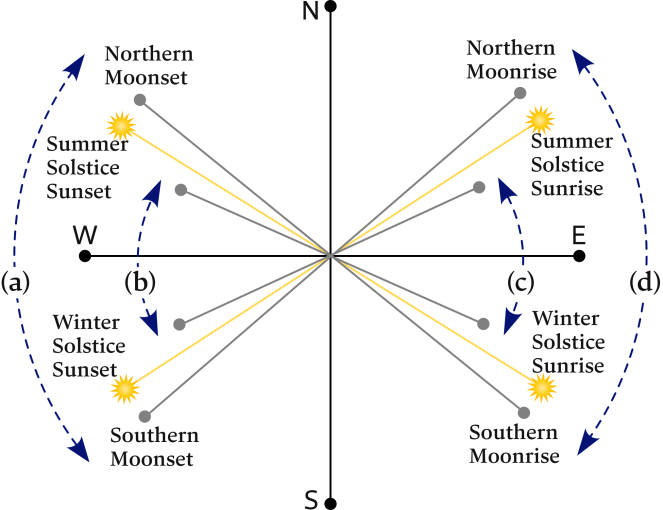
The Earth orbits the Sun along the ecliptic with its axis tilted to about 23.4 degrees. This sets the limit for how high the Sun can appear in the sky, measured in declination either north or south of the celestial equator which is offset 23.4 degrees from the ecliptic.
The Sun is at 0°N at the spring equinox in the northern hemisphere and then rises to 23.4°N at the solstice in June. It then falls back to 0°S at the autumn equinox before reaching its lowest point at 23.4°S at the solstice in December. We see this as the Sun rising to its highest point in the summer and lowest point in the winter, although the actual height it reaches depends on your latitude.
Most of the time the rest of the planets orbit within the ecliptic range set by the orbit of the Sun – i.e. 23.4 degrees. But occasionally a planet will go beyond this range when it goes Out of Bounds (OOB). The Moon does this in an unusual pattern because its orbit is tilted 5.1 degrees in relation to the Earth’s orbit so it can rise 5° higher or lower than the Sun at certain times.
The Moon rises and falls in declination every month but only reaches its most extreme positions during periods of lunar standstill. It rises to its maximum declination of 28.5 degrees north or south during a major standstill, and its lowest declination of 18.3 degrees north or south during a minor standstill. The exact position varies and depends on the positions of the Sun, Moon, nodes, and perigee.
This cycle of rising and falling declination unfolds in a pattern over 18.6 years due to the precession of the lunar nodes. The nodes are where the Moon crosses the ecliptic plane, with the north node ascending and the south node descending. A major lunar standstill happens when the north node is at 0° Aries and a minor standstill happens when the north node is at 0° Libra.
That means we get about 9.3 years of a major standstill followed by 9.3 years of a minor standstill. But like everything in astrology these periods fade in and out in a sine wave and the Moon only reaches its maximum or minimum declination during the middle of the period for about 2 years.
The previous major lunar standstill was in 2006, running from 2001 to 2010. This was followed by a minor lunar standstill in 2015 which ran from 2010 to 2019. The current major lunar standstill started to build in 2020 and reaches its peak in March 2025 before fading out into 2029.
Here’s a graph of the declinations of the Sun and Moon during this period showing the rise and fall of both planets at the latitude of 40°N. You can clearly see where the Moon goes OOB:
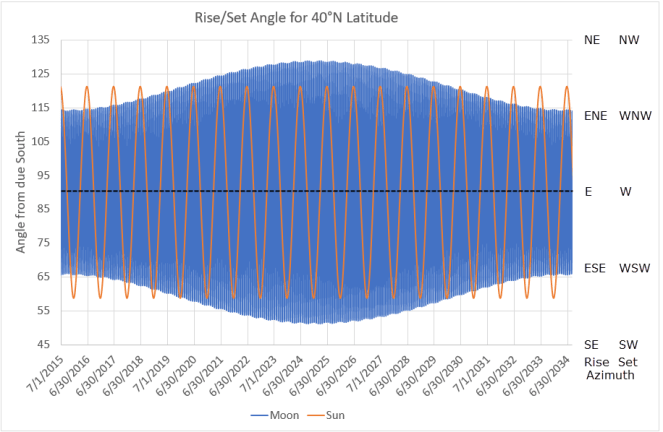
During major standstills the Moon isn’t OOB all the time. Its declination varies every day and goes OOB 2 or 3 times each month for about 5 days each time. At the peak of the cycle the Moon moves through a huge range of declinations from north to south and back again across the ecliptic. This produces large changes in where the Moon rises and sets each day and how high it reaches in the sky.
You can track this yourself by watching the Moon change altitude through each month. It will be lowest when in Sagittarius and Capricorn, and highest in Gemini and Cancer. The Moon is OOB at the start of December 2024 until 5th. It then goes OOB again on 13th until 18th, then again on 27th until 1st January 2025. You can track the dates here.
As mentioned above, lunistice happens when the north node reaches either 0° Aries or Libra. But just to be awkward this date isn’t the same as when the Moon reaches its maximum or minimum declination. The lunar standstill itself happens around the equinoxes and during eclipse season.
During a major lunar standstill the eclipses happen in March or April with the north node, and in September or October with the south node. During a minor lunar standstill this is reversed. Meanwhile, the lunar standstill itself will square the nodes when they’re in Aries/Libra or Virgo/Pisces.
During the current major lunar standstill the Moon got close to its maximum rising and setting positions late in 2023 and has remained high through 2024 and will continue this way into 2026. But the first extreme position happened on 24th September 2024 when the Moon reached 28°42’N while in Cancer and square the nodes in Aries/Libra, 2 days after the equinox.
The north node reaches the equinox point of 0° Aries in January 2025. The true node is at 0° Aries on 12th January, while the mean node is there on 29th January. The Moon will then finally reach its greatest declination a few months later on 22nd March 2025 when it hits 28°43’S while at 29° Sagittarius and square the nodes, again 2 days after the equinox.
After that the highs will slowly get lower and lower until the Moon enters its next minor standstill season in 2029, peaking in 2034.
If you want to observe this yourself, you don’t need to wait for March 2025. In fact, it may be best to observe it during Full Moons even if the Moon isn’t at its maximum declination at the time. Close to the winter solstice, the Full Moon will be higher than the Sun in the northern hemisphere. The Full Moon on 15th December 2024 is at 23° Gemini at 9 am UT when the Moon is at 28°14’N declination. It reaches 28°26’N when it crosses into Cancer at 7.44 pm. That’s still pretty high.
What all this means is that we’re in the middle of a period of extreme behaviour by the Moon and that can have an impact on the way people feel and behave. When a planet is Out of Bounds it becomes highly energised and amplified and can manifest in extreme or unusual ways.
Due to its 18.6-year cycle, the Moon has a period of 9-10 years when it never goes OOB during minor lunar standstills. This is followed by another 9-10 years of major standstill when it goes OOB regularly. So between 2020 and 2029 the Moon will be going OOB more often and that may influence your instinctive reactions and feelings in unusual ways.
In her article Moon Swings, Linea von Horn says that:
“Major standstills affect tides and weather conditions and probably other lunar related phenomenon such as birth rates, public reaction, real estate and the stock market (more volatile during Major Standstill) as well as the economy.”
She says the public response to events may be overzealous and that the further out of bounds the Moon goes, the stronger the response. She continues:
“There is a maverick quality. Reactions and perceptions are extreme and not as controlled. The environment is not very stable. At Minor Standstills, reaction is more controlled and action is taken.”
At first glance this appears to ring true with the behaviour we’ve seen over the last few years. However, people were having extreme emotional reactions to events long before 2020, with 2016 being a standout year thanks to Brexit and the rise of Trump in the US – and that was during the lunar minimum.
I don’t have enough information on things like weather conditions, birth rates, or the economy to know if the rest is accurate. But in financial astrology there’s a well-known link between the extreme declination of planets and sudden reversals in the markets. This applies to other planets as well, not just the Moon.
During the previous lunar maximum that peaked in 2006 we did see rising inflation and a housing bubble that burst in the Credit Crunch of 2008 when the stock market reversed. Perhaps we’ll see something similar when the current ‘everything bubble’ finally pops.
As to the effect on tides, this needs clarifying. At first, I assumed the major standstill would increase tidal forces. But this isn’t the case. Tides are most strongly affected by the minor lunar standstill. The major standstill is the bottom of the cycle for tides when the Moon has a decreased influence. That slowly increases as we move out of major standstill and into minor standstill.
During minor lunar standstill the Moon’s orbit is more closely aligned with the equatorial plane and this exaggerates its gravitational effect on the tides. Tidal forces are increased when the Sun, Moon and Earth are aligned in longitude and declination.
During major lunar standstill the Moon’s effect is reduced and tides are suppressed in most places for 3 years around the peak of the cycle. That means high tides are lower than normal and low tides are higher than normal. At minor standstill that reverses and high tides are higher and low tides are lower.
This was the case during the last minor standstill which peaked in 2015 when there was a lot of serious flooding around the world. Currently tides are suppressed so they’re lower than normal, reducing the risk of flooding. Obviously, there are many reasons why floods happen – it’s not just down to the Moon. But it does mean flooding could become more serious once we leave lunar maximum and start approaching lunar minimum in the early 2030s.
More on the astronomy of tides in this excellent article at Sailing Issues
The apparent discrepancy between astrological expectations and reality reveals that whatever it is that makes astrology work, it’s not gravity!
However, the possibility of heightened and volatile emotions remains valid due to the Moon covering a greater distance in declination each month and this may affect your feelings. Now is the perfect time to observe your moods and reactions and put the OOB theory to the test. You could receive some useful insights into your own feelings and those of others. Personally I haven’t noticed a correlation but you may be different, especially if you’re ruled by the Moon.
Next time we’ll explore how the ancients used lunar standstills in their stone circles…
Thanks for reading! If you enjoy this blog and would like to support my work, please donate below 🍵. Thanks in advance! 🙏❤️

 Jessica Davidson