
Last time we explored the cycle of Venus and how it encodes the Golden Ratio of Phi, the mathematical principle that underlies the whole of nature. That includes the human form as illustrated by Leonardo da Vinci in his famous Vitruvian Man drawing. But he wasn’t the only person trying to square the circle. Similar figures are found in the work of Agrippa, a German Renaissance occultist and theologian.
Heinrich Cornelius Agrippa was a 16th century mage whose work was influenced by Marsilio Ficino and contained elements of hermeticism, Neoplatonism and the Kabbala, as well as Christianity. He lived a colourful life wandering around Europe getting into scrapes and upsetting monks and the Inquisition. But despite his bad luck (and fiery tongue), his books influenced later occultists such as Giordano Bruno and John Dee.
His three-volume work, Da Occulta Philosophia, or Three Books of Occult Philosophy, was published in 1533. Colin Wilson, in The Occult, says it’s “a remarkable work for a man of twenty-four,” and in it, Agrippa states that magic has nothing to do with sorcery or the devil but with gifts such as prophecy. He warns against dabbling in certain practices and tells his readers not to blame him if their spells don’t work.
He even published a retraction, called On the Vanity of Sciences and Arts, in which he says that knowledge only brings disillusionment and the recognition of how little you really know. Wilson says it reads like an anticipation of Goethe’s Faust, and that Agrippa:
“was a genuine mystic, and as he got older, began to feel that magic was a waste of time and that only theology was worth studying.”
Agrippa believed that man was created in the image of God – a true microcosm of the macrocosm. Man is at the centre of the universe and so can participate in the whole, from the elements up through the animal realm of the senses, to the eternal and angelic realms through his Intellect and Spirit, and:
“just as God knows everything, so man can also come to know everything that can be known…”
He demonstrated the perfection of man in his Vitruvian figures, perhaps influenced by the work of Francesco di Giorgio Martini, and published in Book 2 of his opus. The following text is quoted from this translation and paraphrased in parts. This section begins:
“Man, as the most beautiful and perfect work of God, has a more harmonic bodily structure than other creatures, and contains all numbers, measures, weights, movements, elements, and everything, he is the most sublime masterpiece, come to perfection.”
Agrippa goes on to explain that all numbers and proportions were invented from the human body and from these numbers were built temples, palaces and houses. The whole fabric of the world is proportional to man and there’s no part of the human body:
“that does not correspond to a sign of the zodiac, Star, intelligence, a divine name in the idea of God himself.”
And he places man in a circle to show the wholeness of the human form, like this:

But this wholeness can also be represented in a square, “for if a man stands upright with arms outstretched and feet together, he forms an even-sided rectangle; the centre of which is at the lowest part of the belly.”

He then describes how to divide the circle into five equal parts to create the 5-pointed star of Venus, so that when man is placed into the circle, the centre falls at his belly, like this:

Then he returns to a square, “But if the heels being unmoved, the feet be stretched forth on both sides, and the hands lifted up to the line of the head, then the ends of the fingers and toes do make a square of equal sides, whose centre is on the navel.”

“But if the hands be thus elevated, and the feet and thighs extended in this manner, by which a man is made shorter by the fourteenth part of his upright stature, then the distance of his feet having reference to the lower belly, will make an equilateral triangle, and the centre be placed in his navel, a circle being brought about will touch the ends of the fingers and toes.”

Finally we return to a magical square with the human proportions and their secret numbers, “But if the hands be lifted up as high as can be above the head, then the elbow will be equal to the crown of the head, and if then the feet being put together, a man standing thus, he may be put into a perfect square whose sides touch his soles and fingertips, the centre of this square is the navel, which is the middle betwixt the top of the head and the knees.”

You can explore what Agrippa had to say on all manner of subjects in his Three Books of Occult Philosophy here, or listen to this interview with Eric Purdue on the Astrology Podcast.
Other occultists also produced versions of the Vitruvian Man, such as the doctor and astrologer, Robert Fludd. He placed man at the centre of the Ptolemaic macrocosm and the planetary spheres bounded by Saturn. This image is cropped from the front of his epic work Utriusque Cosmi (The metaphysical, physical and technical history of the two worlds, the greater and lesser):
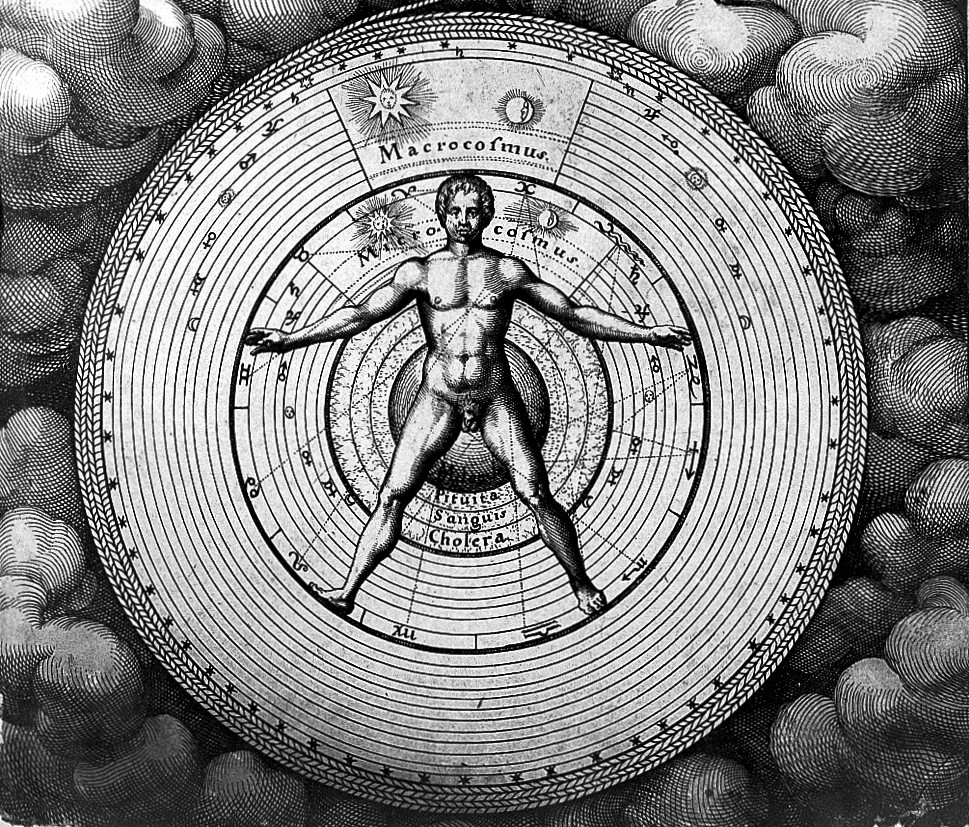
Since I’m currently busy writing Astro Journal 2024 and not doing much else, we’ll have more images from Robert Fludd next time…
Thanks for reading! If you’d like to support my work, please donate below 🍵. Thanks in advance! 🙏❤️

 Jessica Davidson
Not everything but darn close 😏
LikeLiked by 1 person
Interesting…but the Chinese had already worked out something like this with their cun (pronounced tsoon) measurements…each individual has his own cun measurement ( width of thumb at widest joint or the length of the intermediate phalanges of the middle finger, both equal cun measurement)..so that the measurement, for example, of front hairline to occipital base is 12 cun..on every person, using your own cun measurement..and applied all over the body..very cool.. it’s how we find point locations for acupuncture.
LikeLike
The Chinese were the first with everything! Thanks for the info.
LikeLike