
Last time we explored the way ancient peoples tracked the cycles of the sun and moon using stone circles, passage tombs and massive earthworks. They also encoded the angles of the solstices and lunar standstills into objects like the gold lozenge found near Stonehenge. There are many ways to encode astronomical information into objects and one of the most spectacular is conical gold hats.

Four of these incredible cone-shaped hats have been found in various places in Europe but they all share a similar design and construction. They were made during the late Bronze Age from a single sheet of gold covered with symbols that were stamped or rolled into the metal. The symbols on each hat vary but they include circles, dots, wheels, crescents, cones, and eye shapes, all arranged into bands.
The first to be discovered was the Golden hat of Schifferstadt which was found in Germany and is the oldest, dating to 1,400–1,300 BCE. It’s also the shortest at 30cm and made from an alloy containing 85–90% gold, plus silver, copper and tin. The brim originally had a copper wire folded into the edge to strengthen it and inside was the remains of a cloth lining and perhaps a chinstrap.
The other hats date to 1,000–900 BCE and were made from a similar alloy of mostly gold metal. The Avanton Gold Cone was found in France missing its brim and is 55cm tall and has a star shape on its tip along with the other symbols. The Berlin Gold hat is the best preserved and was found in Germany or Switzerland. It’s 75cm tall and also has a star shape on its tip.
The largest of the hats is the Golden Cone of Ezelsdorf-Buch which was found in Germany and is 88cm tall. It doesn’t have a brim but might have had one once, and the symbols include 8-spoked wheels and a star at the top, although they’re hard to see because it was badly damaged.
A couple of the hats were found because they had been deliberately buried in a sacred act to return them to the realm of the gods. The Schifferstadt hat was found buried upright and filled with soil and ashes in a hoard with three bronze axes leaning against it.
This is reminiscent of the petroglyphs found in the King’s Grave at Kivik in Sweden carved onto slabs that lined the walls of a burial chamber. The images include a symbolic depiction of a conical hat between two ceremonial axes. Images found elsewhere in Sweden show a high-status person with a sword, wearing a conical hat and arms raised in prayer.

So these hats belonged to high status individuals who were probably priests and/or kings who used them to track the movements of the sun and moon and make predictions. Perhaps they were also used in ceremonies and as teaching devices to preserve the knowledge over generations.
The ancient astronomers who wore these hats were the original wizards and they certainly had style! Maybe these hats were the inspiration behind the stereotypical wizard hat covered in moons and stars – like the image I use for my Services!. 🧙♂️
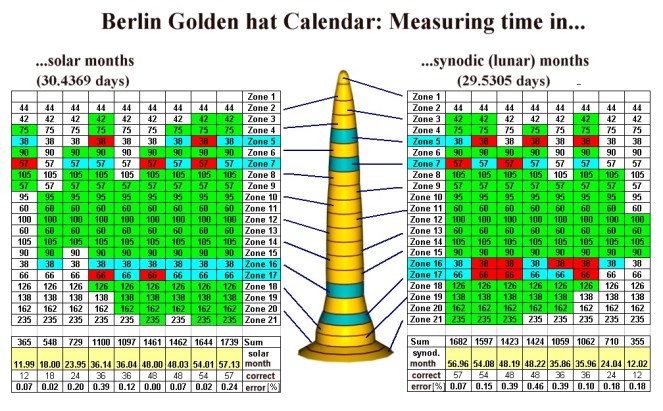
Not all the hats have been studied extensively. But the Berlin Gold hat has been analysed and it contains a lunisolar calendar and counting system that allows you to track the Metonic cycle of 19 years when the sun and moon cycles synchronise. This presentation from Neues Museum in Berlin explains what the symbols represent:

“The star at the tip symbolises the sun, with the sickles and eye patterns representing the moon and Venus, while the circular ornaments can equally be interpreted as depictions of the sun or the moon.”
The eye pattern or pointed oval was a commonly used symbol for Venus in the Bronze Age. This symbol appears on the Berlin hat 19 times which is the same as the number of months in the Venus cycle. But it’s also the number of years in the Metonic cycle so it’s hard to be sure – maybe it represents both.
By counting the various symbols you can work out where you are in the solar and lunar cycles, like so:
“…the number of circles in certain decorative areas equals the 12 lunar periods of 354 days. If the patterns in other decorative areas are added, this gives the 365 days of the solar year. It takes 19 years for the solar year and the lunar year to align again. In the ornamentation of the hat the fact is encoded that seven lunar months need to be inserted into the 19-year cycle.”
Counting like this would also allow you to predict eclipses and follow the lunar standstill cycle. Here’s a table that has been produced showing the calculations that can be made using the Berlin hat:
There’s a great explainer for the Metonic cycle here: How the Moon’s 19-year Metonic Cycle could have been observed in Neolithic Ireland
The gold hats are related to similar artifacts that use the same construction techniques, although they don’t all contain astronomical information. One example is the ceremonial gold cape found at Mold in Wales. This beautiful object was made from a single sheet of gold and is older than the hats, dating to 1,900–1,600 BCE.

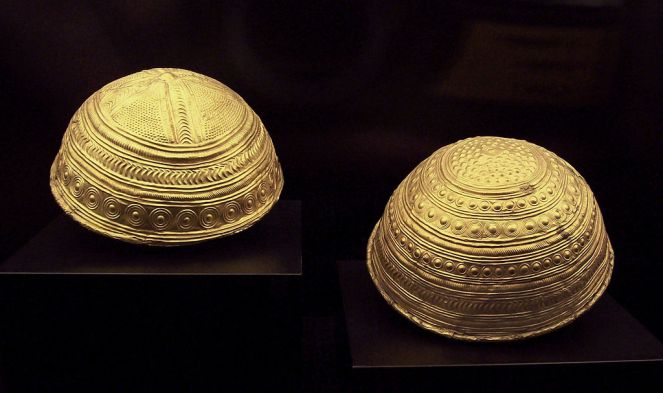
There are also gold bowls that have been found all around Europe. These contain similar symbols to the conical hats, such as a bowl found at Eberswalde which allows you to count the number of solar and lunar years. The base of the bowl has 10 circles plus one at the centre making 11, and there’s a band of 22 discs at the top. You can see this bowl in the Neues Museum presentation here.
Finally we have the ancient Irish gold crown found in Tipperary, called the Comerford Crown after the bloke who bought it. The crown disappeared into a private collection and there’s only a drawing but it shows similar bands to the conical hats with some of the same symbols and a rather natty raised brim:

Similar crowns have been found in other parts of Ireland but none are well preserved. Unfortunately most of them ended up getting melted down for the gold. 😢
Images: Hats; Symbols; Calendar
Thanks for reading! If you enjoy this blog and would like to support my work, please donate below 🍵. Thanks in advance! 🙏❤️

 Jessica Davidson
According to what I have read the most ancient astronomers/astrologists were women, so perhaps these belonged to ancient priestesses and queens or were at least based off earlier designs belonging to them.
Europe at the time these are dated may already have been shifting, plus the shape.
I would greatly recommend the book God Herself: The Feminine Roots of Astrology by Geraldine Thorsten.
It’s a fascinating read detailing the origins of the zodiac signs and such and how meanings have been shifted over time mostly due to ancient politics.
So many other great works like this, curiously unknown even though most have been out for over half a century.
Regards.
LikeLiked by 1 person
The back story for the golden pectoral is extremely interesting since it is thought to have belonged to an Egyptian princess who escaped social unrest in Egypt during the reign of Pharaoh Akhenaten? You can find more at:
https://qudosacademy.org/2022/09/01/the-month-of-september/
leonidas
LikeLiked by 1 person
Interesting – thanks!
LikeLike