
This year the Saturn Neptune cycle that started in 1989 comes to an end and the next cycle begins with the conjunction in 2025–26. These conjunctions happen about every 36 years and the entire cycle represents how we manifest our collective ideals through religion, politics, society and culture. It tests how well our beliefs and visions work in reality and often coincides with periods of dissolution and profound change.
This conjunction brings together two very different archetypes. Saturn represents reality, structure and boundaries, while Neptune represents the dissolution of boundaries and structure and the transcendence of reality in dreams, imagination, spirituality and idealism. For an in-depth exploration of how these archetypes work together read: The Saturn Neptune Cycle and the Dream of Reality
When Saturn and Neptune align, we tend to see these kinds of events:
- Utopian ideals in politics and culture
- Seeing through illusion and revelations of truth
- Death or loss of a dream or ideal
- Disillusionment with established structures or events
- Collective experiences of loss, depression, and grief
- Natural disasters involving water, earthquakes, and flooding
- Pollution, poisoning, epidemics of disease, addiction, and drug reactions
- Outpourings of compassion, sacrifice and aid to help those in need
- Loss of faith and/or renewal of faith and visionary spirituality
- New forms of culture in the arts, music and film that embody romanticism and transcendence
The current conjunction will manifest through the archetype of Aries which adds a fiery and combative or martial dimension. As the first sign of the zodiac, Aries represents new beginnings and the renewal of hope and energy. It’s embodied in the heroic quest for individual glory as well as fighting for a cause or pioneering new ideas. More here: Aries Myths
To get a feel for how this Saturn Neptune conjunction could manifest, let’s explore some previous examples from history. Weirdly, most of these conjunctions happened in March, with one in April and the current one breaking the pattern by falling in both July 2025 and February 2026.
As usual with history, there’s a lot of war going on more or less all the time so it’s hard to tell how much of the following is just business as usual and how much is the influence of Aries. But there are a few notable examples that reveal the archetype in action…
11th March 594 BCE
Saturn Neptune conjunction at 2° Aries square Mars in Cancer while Pluto was also in Aries and Uranus was in Aquarius. It ran from June 595 BCE to February 593 BCE, although Saturn was in Pisces from September 595 to February 594 BCE.
This conjunction coincided with the First Sacred War in Greece between the city of Kirrha and the Amphictyonic League of Delphi because pilgrims were being robbed on their trips to see the oracle at Delphi. The war involved the first use of chemical warfare when hellebore was added to the water supply to poison the city. Its inhabitants were so weakened with diarrhoea that the entire population was slaughtered. 😧
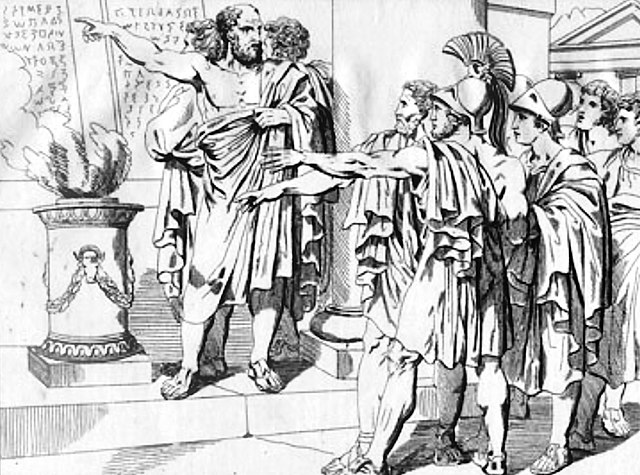
Meanwhile in Athens, Solon was busy implementing democratic and social reforms after an economic crisis. He also established the Ecclesia where citizens met to discuss politics and war and elect magistrates. Solon became chief magistrate in 594 BCE but made the mistake of telling his friends about the debt relief he was about to introduce. They exploited this by taking out huge loans knowing they wouldn’t have to pay them back. Some things never change.
22nd April 92 BCE
Saturn Neptune conjunction at 27° Aries conjunct the Sun and Venus, sextile Mars in Cancer, and sextile Uranus in Pisces, while Pluto was in Taurus. It ran from May 93 BCE to April 91 BCE, although Saturn went into Taurus in May 92 BCE but remained conjunct Neptune.
This conjunction coincided with the Social War in the Roman Republic when they were fighting over who should get citizenship. The war didn’t start until 91 BCE after this transit had passed but events during the conjunction created the conditions for war.
The fighting started between Italian tribes who saw themselves as distinct from Rome. To be given Roman citizenship meant giving up your local citizenship and losing status as a result. Some wanted Roman citizenship while others wanted to retain sovereignty and independence but they also wanted equal rights (Aries). Land reform was also involved since most were farmers and they objected when Rome started seizing their land (Taurus).

23rd March 232
Saturn Neptune conjunction at 16° Aries conjunct Mars, square Uranus in Capricorn, and trine Pluto in Leo. It ran from April 231 to March 233.
By now the Roman Republic had become an Empire and it was busy fighting the Persians with lots of scuffles over territory. Roman emperor Severus Alexander fought to defend his territory against the forces of Ardashir I, the founder of the Persian Sasanian Empire. But there was a mutiny in the Syrian legion in the Roman army who proclaimed Taurinus emperor instead. The rebellion was crushed and Taurinus drowned in the Euphrates trying to escape.
Meanwhile, Pope Heraclas of Alexandria became the first Patriarch of Alexandria to be called ‘Pope’ when his reign started in 232. And in Palestine, Origen founded a school of Christian theology at Caesarea from where his reputation steadily grew.
17th March 555
Saturn Neptune conjunction at 6° Aries conjunct Venus and sextile Mars conjunct Pluto in Aquarius, while Uranus was in Scorpio. It ran from April 554 to March 556, although Saturn dipped into Pisces from October 554 to January 555.
By now the Western Roman Empire had converted to Christianity and collapsed and the capital of the Eastern Byzantine Empire had moved to Constantinople. Byzantine emperor Justinian I was fighting to restore the Western Empire and managed to regain some territory in Africa. He was also fighting the Lazic War with the Sasanian Empire (them again!) in Lazica, or Georgia, on the eastern shore of the Black sea.
Prior to this transit the King of Lazica, Gubazes II, was a vassal of the Byzantine empire but betrayed them by seeking assistance from the Persians. This didn’t improve his situation so by 548 he went begging for help from Byzantium again. During the later war in 555, two Byzantine generals invited Gabazes to watch the siege of a Persian-held fort and then killed him after he accused them of incompetence.
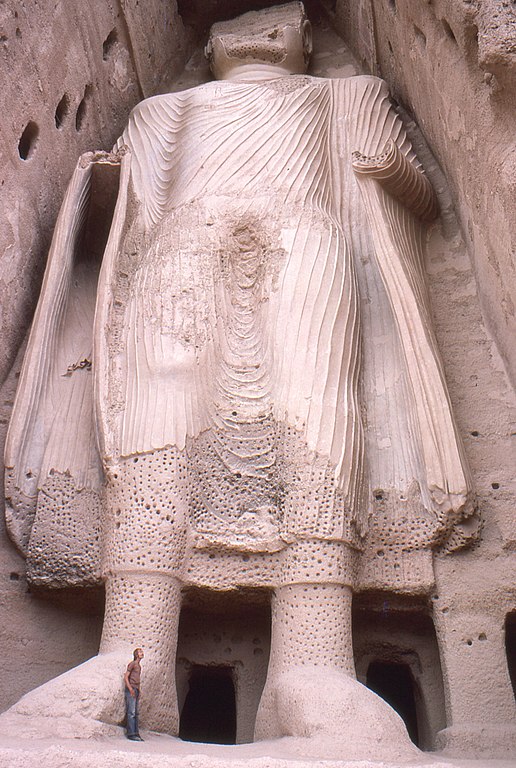
More positively, one of the Buddhas of Bamyan may have been built around this time in what is now Afghanistan. After the huge statues were blown up by the Taliban in 2001 the rubble was carbon dated. This revealed that the 38 meter tall Eastern Buddha may have been built between 544 and 595.
21st March 1380
Saturn Neptune conjunction at 21° Aries conjunct Venus, while Uranus was in Virgo trine Pluto in Taurus. It ran from April 1379 to March 1381, although Saturn dipped into Taurus from June to October 1380, and then again from February 1381.
This conjunction coincided with the Hundred Years War between France and England that started in 1337 and didn’t end until 1453. During this transit France lost control of Brittany to the English. The war was fuelled by growing nationalism and feudal disputes over land and it brought many innovations in military technology and tactics. The chivalric code of conduct and idealisation of bravery reached its peak during the war and declined once it was over, fed by stories of King Arthur and his Knights of the Round Table.
Part of this war included an incident in the summer of 1380 when a Spanish-French fleet raided Gravesend in Kent where they looted and burned several towns in the south east of England. This was set in motion by John I who became King of Castile and Leon in the Iberian Peninsula in 1379. He was known for creating the Order of the Pigeon which had huge feasts where they ate pigeons. 🤷♀️
There were many other battles during this time including the Mongol tribes fighting for succession in the Great Troubles that ended with brief unity under the Golden Horde ruled by Tokhtamysh. While in Lithuania, the region was split between two political systems who shared rulership between Grand Duke Jogaila and his uncle Kestutis. But then Jogaila went behind his uncle’s back and signed a treaty with the Teutonic Knights that started a civil war.
There was also a couple of very young kings at this time. When Charles V of France died, he was succeeded by his 11-year-old son Charles VI. He was placed under the regency of his uncles who squandered the resources that the previous king had built. Over in Denmark, King Olaf II also became King of Norway in 1380 while only 9 years old. He had become king of Denmark at age 5 when his grandfather died and his mother ruled as regent.
Other events include the founding of the Company of the Carracks by King Ferdinand I to provide Portuguese ships with insurance in case of accidents. This laid the foundations for the later expansion of the empire. While in Oxford, New College was founded by the Bishop of Winchester, William of Wykeham, the first university in Oxford to be arranged around a quadrangle.
In Constantinople, Paul Palaiologos Tagaris was a Byzantine monk who got up to all sorts of dodgy shenanigans. He became Latin Patriarch of Constantinople despite being an imposter. While over in England, John Wycliffe started writing his criticisms of the wealth and abuses of the Roman Catholic Church, including the doctrine of transubstantiation. His preaching influenced the rebels in the Peasant’s Revolt which erupted after this transit was over in June 1381.

28th March 1703
Saturn Neptune conjunction at 11° Aries conjunct the Sun and trine Pluto in Leo, while Uranus was in Cancer. It ran from April 1702 to April 1704.
This conjunction coincided with the War of Spanish Succession which started in 1701 when Charles II died without an heir. The war impacted several countries who were fighting over the balance of power in Europe. It spread to North America in 1702 where it was called Queen Anne’s War and the British colonists were fighting the French colonists. The Recruiting Act 1703 came into force in March in England forcing all able-bodied unemployed men to enlist and fight in America. The Act expired in February 1704 as this transit came to an end.
Over in Sweden the Great Northern War had started in 1700 where the young and inexperienced King Charles XII was seen as an easy target. He was opposed by Russia, Denmark, Poland, and Saxony, and although Charles surprised them by fighting back, Sweden lost and Russia increased its power. Meanwhile, Peter the Great founded St Petersburg in Russia in 1703.
In Japan, 47 ronin avenged the death of their former master Asano Naganori by assassinating his enemy Kira Yoshinaka. A year earlier Naganori had been forced to commit ritual suicide, seppuku, for assaulting Yoshinaka after Yoshinaka had insulted him. Due to public support for the ronin’s actions they weren’t executed but were allowed to commit seppuku instead which was more honourable. This happened a week before the exact aspect on 20th March 1703! (Austin Coppock has been talking about this)
On 21st March 1703 Jeanne Guyon was freed from the Bastille where she had been imprisoned for heresy for publishing A Short and Very Easy Method of Prayer. Madam Guyon was a Christian mystic who advocated Quietism, a form of contemplative practice that cuts out the middleman of the Church. She was jailed for more than seven years but was only in the Bastille for four of those years.
The religious persecution of the Reformation continued in the south of France where nine Roman Catholics were massacred in a village called Sainte-Cecile-d’Andorge by a mob of more than 800 French Huguenot Protestants. This was followed by a reprisal a few weeks later against 47 Protestants in a nearby village. (47 again. Hmm 🤔)
Over in the colonies, Frenchman Elias Neau was appointed minister to black slaves by the Society for the Propagation of the Gospel in Foreign Parts. He then established the first school for African Americans in New York City in February 1704 as this transit came to an end. The first two missionaries from the Society had sailed from England to North America in April 1702 at the start of the transit.
There are probably many more examples that we could include. Here’s a summary of the events seen during Saturn Neptune conjunctions in Aries:
- Weak or young or inexperienced leaders
- Religious war and religious persecution
- Criticism of religious ideas
- Betrayal, backstabbing, revenge and mutiny
- Contentious social reforms and fighting for citizen’s rights
- Fighting for independence and sovereignty
- Active religious movements helping the oppressed
- New religious institutions and ideas
Next time we’ll explore the possibilities for the coming Saturn Neptune conjunction in Aries…
Thanks for reading! If you enjoy this blog and would like to support my work, please donate below 🍵. Thanks in advance! 🙏❤️

 Jessica Davidson
It would appear to me that Neptune’s influence in Aries might precipitate the use of chemical weapons in war? That of Saturn the restriction or prohibition of that tactic or chemical weapon. Many of the disasters we are currently seeing in many countries (Fires, Floods, Plagues etc) is simply due to Neptune transiting in a critical degree in Pisces! On the other hand soldiers may be reluctant to enter the warzone. What may be of some significance is the influence of Pluto in Aquarius-surely the water-bearer would be reluctant to enter into armed chemical conflict?
LikeLiked by 1 person
Yes, indeed. Thanks to Pluto in Aquarius we’ll see a lot more use of drones and tech in war to keep the soldiers out of it.
LikeLiked by 1 person
a really interesting article.. thank you so much 🙏. Also interesting that the previous commenter has Pisces on the 5th house cusp, as do I (it’s empty!) however I use the equal house system and have Virgo on 11th cusp where my Neptune is but in Libra. Neptune ruling the 5th! I’ll say no more! 🙄😉
LikeLiked by 1 person
Hello Jessica.
I don’t recall how I came upon your work, but once I did, I started reading astrology articles in your archives. I found many quite helpful, and your writing clear and informative. I also purchased Astro Journal 2025, which I’m using in only a very limited way, not because of how it’s written or presented, but because my mind doesn’t retain the extraordinary detail involved in the movement of planets and their interactions. In my meditation practice I strive to be receptive and elastic, where I landed in the midst of the complexity. Natally, I have planets in ten of the houses, with configurations like a t-square on the cardinal cross, a yod, and three grand trines. At the moment, much is happening in my fifth house, including the Saturn-Neptune conjunction and the progressed Moon, where my Sun and Eris are located, and where, for the past forty years, I thought Mercury and my South Node were, all in conjunction.
Which is a long-winded way of arriving at my question. This weekend I did some research about what it might mean to have Pisces on the cusp of the 5th house. This turned out to describe several experiences/ways of being that I’d never understood before. I found the information at a website called astrolibrary.org. The site has a birth report tool. I plugged in my data and discovered that, according to this tool, my Mercury and South Node are considered conjunct in the 6th house, with my North Node in the 12th (versus the 11th where I’d always thought it was). Everything else about my natal chart was the same as the one I’ve always used (as an aid to evolving; I’m not an astrologer or an aspiring one). The only difference I saw was that their chart used something called Campanus, not Placidus. Could this be the difference in the calculation? If so, is one considered more accurate than the other?
If you’ve reached the end of my email, thank you for taking the time to read it, and possibly to reply. I’m principally a painter, but I also write (short stories; grant applications in the past). I think our technical writing styles are similar, which is, in part, why I enjoy reading your articles.
Warm wishes for the new year whether you find time to respond, or not. claudine
LikeLiked by 1 person
Glad you enjoy the articles, Claudine, and are finding the Astro Journal helpful. Being receptive and elastic is a great way to handle all the crazy astrology this year!
The differences between the two house systems come from the way the house cusps are calculated. I don’t know if one is more accurate than the other – I think it comes down to personal preference and what works for you. If you’re getting good results with Placidus then stick with it. You could try other house systems to see what effect they have on transits, etc. but unless you’re willing to get into the weeds of it, it can be frustrating and time-consuming.
Best of luck with the Saturn Neptune transit!
LikeLike
Thank you for your prompt and generous reply, Jessica.
This shift in the nodes lifts a burden I’ve felt plagued by. Based on that, Campanus seems worth at least some further investigation. I’ll do that.
Best and warm wishes. claudine
LikeLiked by 1 person
Hi there,
With regard to which is the best house system to apply I should add that it depends for the most part on where you were born, that is anywhere far above the tropics of Capricorn and Cancer. For example Greenland, N. Norway and say the Hebrides are so high in latitude that the planets in the natal chart fall into one or two houses. This makes interpretation difficult to analyse. My friend who was born in Norway suggested Koch house system when this happens. In the early period I studied astrology I used the equal house system which in actual fact was pretty accurate-as I became familiar with different house systems and in what instances they were deployed, eventually I chose Placidus as a basic system and only deferred to another system if I discovered an anomaly or inconsistency where interpretation is involved in time or place. As you did not mention where you were born I am unable to advise further.
leonidas
LikeLiked by 1 person