
Neptune is now in Aries and we can expect to see an increase in the idealisation of certain aspects of masculinity, such as heroic action, bravery and courage. But there could also be an increase in misguided or delusional actions that come out of the wounded masculine psyche. So now is the perfect time to learn more about positive expressions of masculinity.
 A good place to start is He: Understanding Masculine Psychology by Robert A Johnson, a Jungian analyst. The book explores what it means to be a man through the myth of Perceval and his quest for the Holy Grail. It’s an excellent source of insight for men to discover more about themselves but also for women to learn more about the men in their lives, as well as their own inner masculine side.
This isn’t about gender. Everybody has both masculine and feminine sides to their psyche with a tendency to lean more to one side than the other. The ideal is to integrate both sides so you have access to both expressions, whether you’re a man or a woman. Integrating the opposites doesn’t mean they get merged into a homogenised blob of androgyny. It means you can express both sides of your being in an appropriate way.
Our ideas about what men and women are have been distorted for such a long time that it’s hard to know what a genuine and healthy expression of these energies means or feels like. And this confusion about the difference between masculine and feminine energies feeds into the crisis of masculinity, as well as toxic expressions of femininity too.
To explore this crisis Johnson analyses the Grail myth using the earliest version: Perceval, the Story of the Grail, written in French in the 12th century by Chretien de Troyes. Unfortunately he never finished the tale so the ending comes from other versions written later in the 13th and 14th centuries. There are also elements from Celtic mythology that have crept into the story, including the Grail itself which may be related to the cauldron of the Dagda.
The Perceval story reveals how a boy grows into a man through three stages of evolution: innocence followed by a fall into self-consciousness or ego, and then finally enlightenment. The final stage represents a conscious reconciliation of the inner and outer worlds in a state of wholeness. This is also known as the individuation process and it applies to women just as much as it does to men.

The story begins with the Fisher King who is wounded and his kingdom is in ruins, although he’s the guardian of the Grail. He’s either wounded in his thigh or genitals in a fight, depending on the version, or burnt by eating hot salmon, which is a weird one. The wounding by salmon happens after the young prince wanders into a camp where salmon is cooking and he takes some but drops it because it’s too hot.
The salmon represents Christ and probably also relates to the Salmon of Knowledge in Irish mythology and the early deeds of Fionn mac Cumhaill. It represents a level of consciousness that the prince wasn’t ready to understand so encountering it was a wounding experience – an initiation into conscious self-awareness.
In other versions the wound comes from a clash between the Fisher King and another knight, a Muslim pagan. The King kills the pagan knight but is wounded in his thigh. This represents a clash between vision and sensuousness or instinct which can trigger evolution to a higher level but can also be psychologically destructive. As Johnson says,
“it leaves us the legacy of our sensuous nature killed and our Christian vision terribly wounded.”
‘Christian’ could also just mean transcendent or divine. The wound to the thigh is a wound to the life force or ‘generative ability.’ It creates a split within ourselves and diverts the life force into the unconscious, killing our passion and making it hard to feel in an authentic way.
Most modern men (and many women) receive the Fisher King wound early in their lives which alienates them from their feelings. It represents a loss of innocence or a feeling of being cast out of Eden and pushed into duality and painful self-consciousness. This wounding is necessary for the growth of consciousness and individuation. But we also tend to look for solutions in the wrong place – i.e. outside of ourselves.
Johnson says it’s usually women who notice when a man has become lost in his wound without realising it. The feeling of being incomplete creates horrible suffering which drives him to do idiotic things in search of a cure. It has to be said that women do this too, although maybe in different ways.
But the cure can only come from within. The Grail quest is needed.
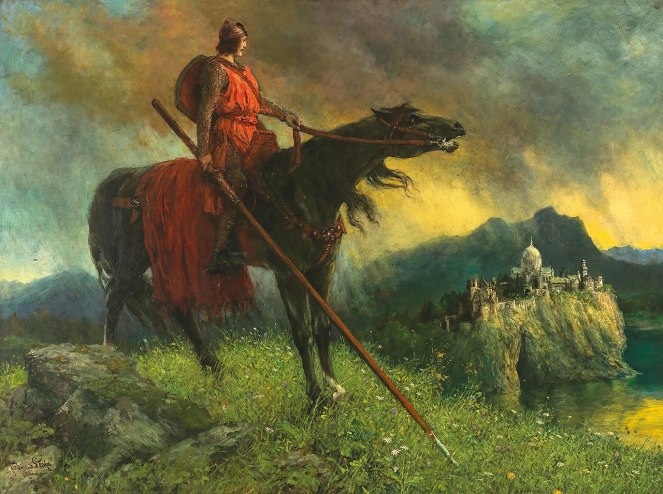
So the Fisher King (and we) are in this terrible state. He’s the guardian of the Grail but can’t partake of its healing qualities. He can’t live fully but can’t die either. This is similar to the wound that Chiron receives that he’s unable to heal despite his great wisdom. For more on this see Chiron Myths, and The Fisher King film which explores the same myth.
The cure for the Fisher King’s wound comes from Perceval, an innocent fool who doesn’t know what he’s doing, as Johnson explains:
“A man must consent to look to a foolish, innocent, adolescent part of himself for his cure. The inner fool is the only one who can touch his Fisher King wound.”
This means returning to a younger part of the psyche, the part untouched by the wound. But that doesn’t mean regressing or crawling back into the womb! In fact, before Perceval can heal the King, he has to go through a whole process of growth so he can ask the right question when the moment arises.
The process of individuation includes confronting and integrating the shadow, dealing with the Mother complex, and integrating the anima (in a man) or animus (in a woman). Perceval goes through this process and all the characters in the story can be seen as representing different sides of his character that he needs to overcome or accept on his journey to wholeness.
His journey starts almost by accident. Perceval leaves home because he wants to become a knight but doesn’t really understand what that means. Although he leaves home, he’s still attached to his mother and doesn’t know or understand himself. He’s searching for an identity and a sense of meaning and thinks he’ll find it out in the world.
On his quest he defeats the Red Knight and gains his armour, overcoming the shadow side of his masculinity. He receives training in how to be a knight from his grandfather who tells him to search for the Grail castle. He also tells him to ask, “Whom does the Grail serve?” once he gets there.
In the meantime, he meets Blanche Fleur, a damsel in distress who needs Perceval to rescue her kingdom from a siege. She represents his anima, the inner feminine side of a man’s psyche and the source of his creativity.
“Creativity in a man is directly linked with his inner feminine capacity for growth and creation. Genius in a man is his interior feminine capacity to give birth; it is his masculinity which gives him capacity for putting that creativity into form and structure in the outer world.”

The anima isn’t the only feminine part of a man’s psyche. Johnson outlines six feminine elements in a man: his human mother, his mother complex, his mother archetype, his fair maiden or anima, his wife or partner, and Sophia, the Goddess of Wisdom or the feminine side of God.
The mother archetype is his relationship to the essential nurturing quality of life or mother nature. But the mother complex is a regressive part of the psyche that pulls you back into being dependent on your mother like a child. This is often expressed in moods and feelings such as defeatism, wanting to give up, and even an unconscious death wish. The mother complex is:
“pure poison in a man’s psychology.”
It’s pure poison for women too and must be overcome by slaying the dragon. That doesn’t mean killing your mother! It’s important with these archetypal energies not to literalise them or project them onto people in your life. Confusing the levels of reality like this causes no end of problems in relationships and society at large.
Johnson explains that a son must leave his mother, not just physically but also emotionally and psychically, otherwise she’ll dominate his psyche and he’ll never grow up and become a man. Later he can return to his mother and form a new relationship with her on a different level. But first he must transfer his affection to his inner feminine side or to another person in relationship.
Sometimes a man can become caught in his feminine side which cuts him off from true feeling and makes him behave irrationally. When this happens, he has fallen into a mood and is possessed by the inner feminine. This can happen with women too when they become possessed by their inner masculine and won’t stop talking and criticising.
True feelings give you a value structure and sense of meaning and allow you to make sense of your experience. Moods are emotions that are based on something internal and largely self-constructed or imaginary. They’re a product of wilful blindness or deliberate unconsciousness where you try to avoid dealing with a real situation. Moods tend to take over a man’s life when the anima isn’t integrated and balanced in his psyche.
“Even a good mood costs one relationship. All ability to relate, objectivity and creativity, come to an end when mood takes control. In Hindu terminology, serving the goddess Maya (the equivalent of our anima moods) costs one all reality and substitutes a vaporous unreality in its place. … One literally sells one’s birthright for a mess of illusion.”
As long as you’re stuck in a mood – whether you realise it or not – you’ll never find the Grail.

Back to the story. On his travels, Perceval accidently stumbles across the Grail castle where he witnesses a strange ceremony. Three objects are brought out and displayed: the lance that pierced the side of Christ, the serving dish of the last supper, and the Holy Grail. Perceval is so overwhelmed that he forgets to ask the question. When he wakes in the morning, the castle is deserted so he leaves.
He failed this first test because he wasn’t conscious enough. He still doesn’t know who he is and must continue on his quest, having battles and learning about himself before he’s ready to return to the castle. He must earn the right to return.
Do women need to quest for the Grail? According to Johnson, they don’t:
“A woman experiences the Grail in quite a different way from a man. She never leaves the Grail castle and keeps a sense of beauty, connectedness, at-homeness in the universe that a man does not have.”
This is an absurd statement and isn’t true. Not for me anyway. Maybe it’s true for some women but the modern education system makes it increasingly less likely. Most of us have had our instincts and feminine feelings ‘educated’ or beaten out of us somewhere along the way. For more on that read: The Handless Maiden
Once you’ve had a glimpse of the Grail castle you want to go back. This may not be a conscious desire but something that drives you to search for meaning everywhere – a kind of hunger or restlessness for more. You may not even know what’s missing. There’s just a vague feeling of loss or incompleteness.
The search can lead to disillusionment and despair, especially at midlife when you may be confronted by your failure even in the midst of outer success. To deal with this challenge you need to accept the nature of the quest as one you must do alone. You can’t compare yourself to others or measure your success against theirs. You must become yourself – who you really are, deep down.
Perceval finally stumbles across an old hermit living in the forest who berates him for failing to ask the question at the castle. The hermit represents a deeply introverted part of the psyche that’s been “storing energy in a far-off corner waiting for this moment.” The hermit shows Perceval the way back to the castle – it’s not far, just down the road. In fact, it’s always been that close.
The castle is an inner reality and it can’t be found in the outer world. You can only discover your way back by turning inwards. However, Johnson says that most of us need some sort of outer exploration to fuel the inner search until we’re ready to stop questing in the outer world.
“the Grail is always immediately at hand and is won more by peeling away the insulations around it than by any act of creation.”
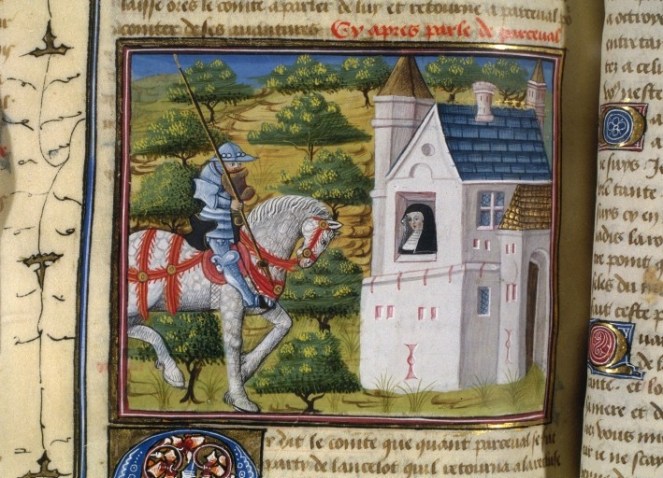
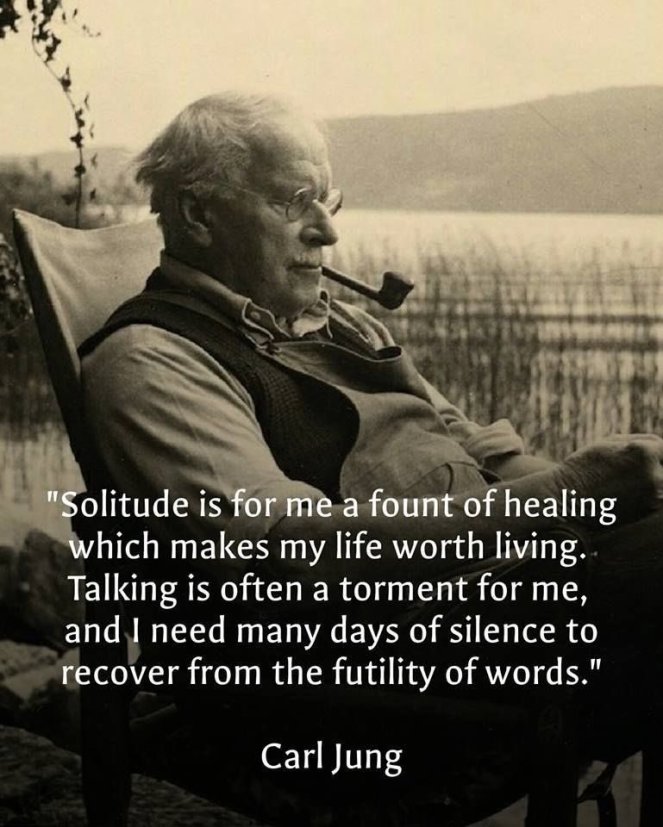
We need to mention the natural hermits here. Some people are naturally introverted and spend most of their time hanging out in the forest on their own. He says these are “born hermits” who must remain in solitude symbolically speaking, although sometimes they may choose to go it alone for a time.
As a ‘born hermit’ I appreciated this section of the book. Natural introverts have a hard time in our very extrovert culture and they don’t get to go on many quests or vanquish dragons – at least, not in the so-called ‘real’ world.
“Such people receive very little encouragement or reinforcement these days and they often have a lonely and solitary life to lead.”
It’s not that bad, honestly. Being pushed towards futile quests that will obviously fail or forced to endure inane extrovert bollocks is much worse!
But one day, a time comes when the hermit’s wisdom is needed so you can transition to the next stage of your life. Born hermits know how to do this. They sit in their little shacks and do their inner work – perhaps with “Here All Dwell Free” written above the door. But they don’t do that work for themselves. They are:
“storing up energy so that they may serve mankind when their quality is crucial and of the highest value.”
This quality is usually overlooked and when it is noticed it’s often denigrated. But it could save your life one day – whether it comes from within yourself or from a teacher or guide or friend. So:
“Please be good to your own hermit quality or the born hermit in your circle of friends.”
With the help of the hermit Perceval makes it back to the castle and sees the same ceremony. This time he asks the question: “Whom does the Grail serve?” The answer is obvious: it serves the Grail King, i.e. the Fisher King, who is now healed and returned to wholeness.
In the end, Perceval finds meaning and becomes whole by sacrificing his own needs for a higher purpose – the needs of the Fisher King. He asks the question not for himself, but for the King. Instead of chasing worldly goals and materialistic desires, he puts his energy into something more real and true.
The Grail King represents the Self so the question points towards the centre of your being and the source of meaning in your life. When you ask the question, it redirects your energy from the ego to the Self. The ego asks the question but doesn’t have to answer because the Self is the answer.
The quest for the Grail is really a search for God who is always present and so cannot be sought for. The same journey is illustrated in the Ox herding pictures where the goalless goal is to return to your Buddha nature – that which you already and always are.
“The object of life is not happiness, but to serve God or the Grail. All of the Grail quests are to serve God. If one understands this and drops his idiotic notion that the meaning of life is personal happiness, then one will find that elusive quality immediately at hand.”
Explore all Neptune in Aries posts here
Thanks for reading! If you enjoy this blog and would like to support my work, please donate below 🍵. Thanks in advance! 🙏❤️

 Jessica Davidson