
As part of my exploration of Neptune in Aries I’ve been digging through my notebooks for inspiration and found some ramblings that relate to the challenge of non-action that we explored last time. The notes came out of my research into how to cure the sense of lack that drives Pluto in Virgo and humanity in general, as well as the struggle to get out of your own way on the spiritual path.
I’ve been stuck in the impasse of the dark night or Great Doubt of Zen for years and it’s exhausting. Every time I get close to breaking through, I hit a brick wall of resistance built from deeply buried wounds in my psyche – wounds of guilt and shame and a basic sense of not being enough. There’s also a constant low-level anxiety, like a hum in the background that you barely notice. Relaxation and meditation help but they don’t cure it.
I realised that the resistance is an unconscious rejection of my true nature as one with the divine (Pisces polarity point for Pluto in Virgo), and the pain of this resistance was becoming unbearable. It’s a vicious cycle – I reject it because I’m scared and I’m scared because I reject it.
But the more I try to free myself and break through the resistance, the more stuck I become. I keep running up against the darkest part of my psyche – the wound that never heals. So I returned to an article by David Loy called Avoiding the Void looking for answers. He lays the problem and its solution out clearly.

The fear that underlies so much of our activity in the world and drives our anxiety isn’t fear of death but the suspicion that you’re not real – that who you are, your ego or sense of self, isn’t solid or lasting. So the anxiety is really a fear of the void or nonself in Buddhist terms.
That means the feeling of lack is an intrinsic part of the sense of self, the ego or false self. And this drives you to make yourself more real or solid to compensate. He explains:
“If the sense of self is a construct, it can attempt to realize itself only by objectifying itself in some fashion in the world. The ego-self is this never-ending project to objectify oneself, something consciousness can no more do than a hand can grasp itself or an eye can see itself.”
The result of this failure to objectify yourself – to become real – is a constant feeling of lack. It’s the shadow of the ego and you can’t escape it.
“The trace of nothingness in our being, of death in our life, is a feeling of lack.”
You experience this as something being ‘wrong with me’, an ontological guilt or anxiety at your core. This drives compulsive behaviour, and we tend to rationalise the guilt in various ways to explain why it’s there – original sin is one example. But Buddhism has a solution to this lack and dread of nonbeing.
“If it is nothingness we dread, then we should become no-thing. The dichotomy between being and nonbeing can be conflated by yielding to the side we have been rejecting. In ceasing to deny my groundlessness I discover, paradoxically, that utter groundlessness (nonbeing) is equivalent to full groundedness (being).”
The ego, or false self, responds to this by assuming it means it has to die, which just triggers the anxiety and reinforces the problem. Embracing nonbeing sounds like embracing nihilism but it’s not because the assumption about what happens is based on a misperception of reality.
It’s very hard to see your way through this problem because the ego is trapped inside its own little hall of mirrors and can’t see reality clearly. David Loy says the letting go that you need to do isn’t easy because it’s not obvious to your consciousness – it’s hidden behind the ego itself.
“The ego cannot absolve its own lack because the ego is the other side of that lack.”
Hence the focus in religion on receiving forgiveness and grace from God. Buddhism doesn’t bother with all that! The Buddha refused to speculate about metaphysics and just focused on what you can actually do to free yourself.
“…the guilt expended in these situations should be converted back into ontological guilt, and that guilt must be endured without evasion; the method for doing this is simply nondual awareness, which meditation cultivates. The result is that one becomes profoundly guilty and feels completely worthless, not because of anything one has done but simply because one is.”
This is what the dark night of the soul is! You fall into this hole where you see how utterly wretched you are and you can’t escape it.
“There is nothing one can do with it except be conscious of it and bear it and let it burn itself out, like a fire that exhausts its fuel, which in this case is the sense of self.”
He goes into a lot of detail about how all this works and the article is well worth reading and studying. But in essence, you have to stop chasing things that aren’t real, stop trying to make yourself into something or someone, and let it all go.
It also made me realise that I haven’t done anything wrong to cause my feelings of guilt or shame or lack. Those feelings come from the pain of existence which I misinterpret due to the blindness of my false self. The conditioning of the false self makes me assume that if I’m suffering it’s because I’m being punished. But it’s not true.
Pain makes you feel helpless and, in an attempt to regain a sense of control, you try to become more real or solid – you reject reality and withdraw behind your ego fort and build the walls higher and stronger. But this doesn’t stop the suffering. Only seeing through the illusion of the separate self will bring the ego fort tumbling down.
So I can start by not beating myself up for feeling the way I do. It’s just existential – not personal. There’s no one there to be guilty.
The sense of self then can be seen as a “pattern of evasions” which is why it feels so uncomfortable. This is why people are always trying to escape themselves through constant activity, work, drugs, alcohol, sex, gaming, TV, starting wars – almost everything you do, including spiritual practice.
“no wonder we never realise who or what we are, for such a consciousness has no being, only a function. This makes the sense of self into a double lack: an ungrounded awareness whose task is to repress anxiety.”
You deal with this ontological anxiety the same way as the guilt – by letting it become fear. You stop projecting it onto things to be scared of and just let yourself feel scared without trying to escape it.
There are some important points he makes about totalitarianism and how it’s used to allay anxiety in society. That’s why people will vote for tyranny – because they’re scared – not just because the ‘powers that be’ have made them scared, but because of the ontological anxiety of being human, and it’s this that drives history.
“Efforts to realize myself symbolically mean I give power over myself to those persons and situations which can grant or refuse the symbolic reality that I hope will fill up my lack.”
To solve this problem you have to do shadow work and take back your projections onto the world and others. You have to own your feelings and feel them as they are without evasions. You have to see the truth of what you are: your delusive sense of self and its emptiness.
Buddhism talks about duhkha – suffering – and says we suffer because we don’t know who we are. But:
“duhkha is not something we have but something we are.”
As long as you cling to your false self then you will suffer because they’re really the same thing. The sense of self is suffering – it is anxiety and guilt. In other words, you are the problem.
But ‘you’ isn’t what you think it is.
And no, this isn’t nihilism because there was never any ‘self’ to destroy – you just see through the illusion of separation. There’s no separate self, just a series of ever-changing webs of relationships.
While we’re trapped in the illusion we deal with our anxiety and the fear of being nothing by trying to become real, or self-existing. We try to be Pinocchio because we want to be a real boy. But this can’t work because you’re not self-existing – nothing is – only God.
So you’re trying to do something impossible and will always fail. No matter how far back into your ‘empty’ previous lives you dig, you’ll never find the beginning, the root, or the cure. It’s not there. No therapy will cure it. No pill. Only the truth of what you really are.
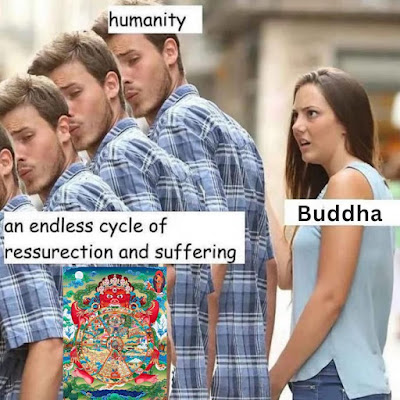
To see through the illusion of separation you need to understand the four-value logic of Nagarjuna who said:
“The self-existence of a Buddha is the self-existence of this very cosmos. The Buddha is without a self-existent nature; the cosmos too is without a self-existent nature.”
This paradox is similar to the Advaita statement: God alone is real; the world is illusory; God is the world. But the point isn’t to try to become Buddha. You’re already Buddha! You need to let go of all the things that stop you from seeing that.
“Forgetting ourselves is how we lose our sense of separation and realise that we are not other than the world.”
That doesn’t mean falling into nothingness or a void, although it’s often described as Void. You have to stop your mind from constantly reflecting back on itself in a hall of mirrors. It does this in an attempt to get hold of itself, to find something real and objectify itself. That’s what the endless thinking and activity is trying to do.
Underneath all this frenetic activity is the void. But that isn’t what you think it is, as Huang-po said:
“Men are afraid to forget their minds, fearing to fall through the Void with nothing to stay their fall. They do not know that the Void is not really void, but the realm of the real Dharma.”
Loy explains:
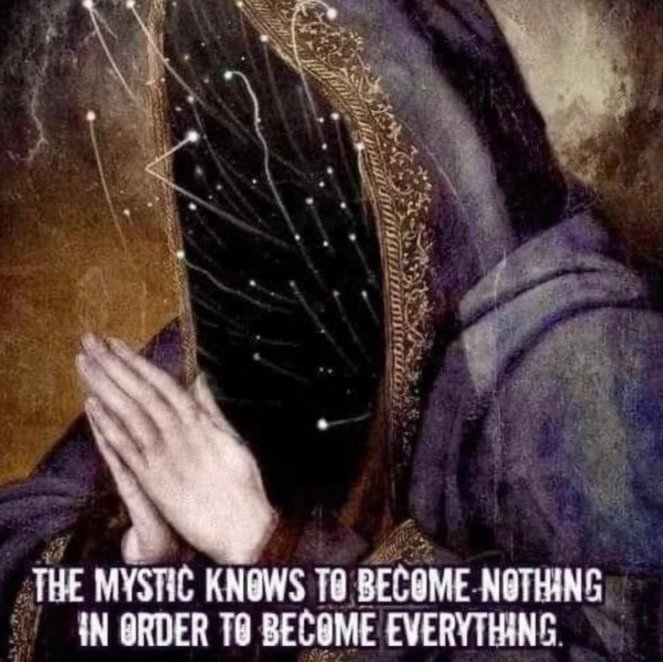
“when consciousness stops trying to catch its own tail, I become no-thing, and discover that I am everything – or, more precisely, that I can be anything.”
Of course, the ego/false self immediately seizes upon this and decides that sounds good and misunderstands the whole thing and turns itself into a monster. But the point is, you can only become what you truly are by letting go, not by grasping. You let things be. Easy to say, difficult to do!
Read the whole essay here: Avoiding the Void: The Lack of Self in Psychotherapy and Buddhism by David Loy
Next week more ramblings from my notebook on the Great Doubt…
Image: Mirrors
Thanks for reading! If you enjoy this blog and would like to support my work, please donate below 🍵. Thanks in advance! 🙏❤️

 Jessica Davidson