
Last week I shared my notes on an essay by David Loy on Avoiding the Void and how to overcome the false self in spiritual practice. This involves letting go of the effort to be someone and surrendering to your true nature as one with the divine. It’s easy enough to write about but actually doing it is something else. Steve Antinoff explores this dilemma in his essay Spiritual Atheism and in this post, I’ll share my rambling notes on his ideas.

There comes a time in everybody’s spiritual practice (or life) when they hit a wall. If you go deep enough that wall can become a serious problem until it magnifies into what the Buddhists call the Great Doubt, or the dark night of the soul of Christianity. This is a good thing, although it doesn’t feel like it while you’re in it.
As we discovered last week, you eventually reach an impasse where you realise that it’s you that is the problem. You’re getting in your own way. You’re trying to free yourself from yourself – which is insane, but also a paradox. In Zen it’s called a koan which is a dilemma that you can’t solve with your normal thinking.
Steve Antinoff describes the problem of your existence as a ‘natural koan’ – an existential dilemma. The point of the koan given to you by a Zen master is to force you into that existential dilemma by internalising the koan. But you don’t need the koan if you’re already stuck on the real existential problem.
The basis for his argument is atheism and the idea that God can’t exist:
“Spiritual atheism begins with a triple realisation: that our experience of ourselves and our world leaves us ultimately dissatisfied, that our dissatisfaction is intolerable and so must be broken through, and that there is no God.”
I agree with the first two but not the final one. But it depends on what you mean by God. I used to be an atheist but that slowly transformed into agnosticism and then mysticism. I’ve glimpsed something mysterious and incomprehensible and unknowable that I’m happy to call God, but I could be wrong. How would I know? It reminds me of Rat Hermeneutics by Owen Cyclops (brilliant – please click through to look at it!).
All I know is that faith in this mysterious reality doesn’t seem to help me much when I’m up against the impasse and trapped in my own mortality. I need something else to push me through the eye of the needle.
Whether you believe in God or not, the problem is with the transitory nature of the world and the impossibility of finding happiness there. Chaung Tzu said, “The 10,000 things ranged around us and none of them are worthy to be our destination.” The Upanishads say, “There is no joy in the finite.” And Buddhism talks about true peace only being found by freeing yourself from life and death, the wheel of samsara.
The problem is existential anxiety and it can’t be cured through therapy, only through religion.
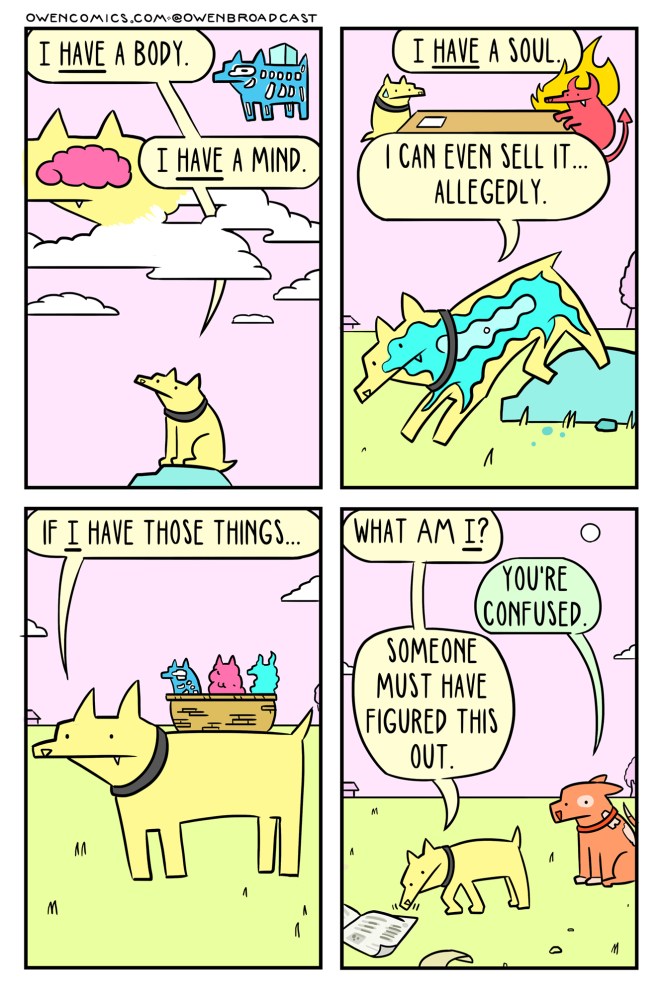
The ego is the problem – not ego in the Freudian sense but as in the ‘I’, your sense of self separate from the world. You are kind of trapped in this ‘I’ and it’s a lonely place to be. You try to find meaning in society and politics and relationships and creativity and so on, but all these things fail insofar as you use them to seek for peace, happiness, liberation and ultimate meaning.
Every attempt to solve this problem fails because doing so reinforces the problem, as we saw in the previous post. He says various spiritual teachers say the solution to this problem of the ‘I’ is found in divine grace, but he rejects this because of his atheism. Grace does come into it though, as we’ll see.
The problem is what to do when all your efforts to meditate through the problem fail. Most people just avoid the problem in various ways. You turn away from the existential anxiety and avoid the void. He says boredom is the first symptom of the abyss. Underneath the boredom is the loneliness. And underneath that, the abyss and the existential terror of it.
This is why I’m stuck. I want to be free of the fear but also, I don’t, so I avoid practising and letting go. Because wanting to be free of the fear is the same as wanting to be free of myself. Who would I be if I was free? The fear is familiar, even if it’s painful. But now it has become too much. I can’t live with myself but don’t know how to live without myself.
The frustrating thing is I know there’s a way through because it’s happened multiple times. But I always worry that next time (if there is a next time) ‘I’ might not return. Of course, that wouldn’t be an issue because I would be free and the fear would be gone. So what’s the fucking problem?! 🤪
The problem is there’s no way to solve the problem – no path. It’s called the pathless path and the gateless gate for a reason. Trying to free yourself traps you harder. It’s a Chinese finger trap. This is where you hit the Great Doubt of Zen – the impasse – an inner crucifixion.
People can meditate for years and not free themselves from the existential terror. You can escape for a bit into spiritual bypassing but that fear will be there underneath. He says Richard DeMartino called meditation a local anaesthetic, a way to make your ego prison cell more comfortable.
Ramana Maharshi explained the difference between temporary cessation in meditation and enlightenment as the difference between a bucket (the ego) submerged in a well (Brahman/God) but still fastened to a rope, and the bucket being cut free from the rope.
Meditation can also leave psychological problems unresolved because you just let things go rather than confront them. More spiritual bypassing.

The solution to the existential impasse is to stop running away from it, just as David Loy says in Avoiding the Void. Stop bypassing it. But you also have to give up trying to solve it. There’s no way through – you can’t get past yourself – you are in the way.
This is where grace comes into it. You have to surrender – not with the idea that if you surrender, you’ll break through. If you do that, it won’t work. You have to reach the point of utter helplessness – totally stuck – and then give up knowing that you’re fucked.
This is the dark night of the soul. You have to sit in that darkness, in the impasse and not try to escape from it. Let it crush you.
“When every recourse and resource by which the ‘I’ maintains itself are expended, it collapses…The phoenix – what Hisamatsu calls ‘the Self without life and death living in the midst of life and death’ – soars out of its own ashes.”
The problem is you keep avoiding the wound. It’s the nature of the ego to keep moving and running away from its root. So you have to stop it from running – checkmate it – become one with the wound.
He says you don’t have to be any good at meditating because it’s not really going to help you – it’s another avoidance. You have to enter the dilemma or impasse and stay there and not allow your mind to escape.
Of course, it always does. It spins off thinking random shit. I’ve never had a real breakthrough while meditating. It has always come by accident or when I’m tormenting myself at 3 a.m. with the fact of my impossible existence – the impossibility of remaining trapped inside my own skin for a second longer. It’s unbearable, a kind of torture. And then suddenly, it’s gone – the pain and me – and there’s just THIS.
I don’t know how to do it but it has happened. An internal implosion into the void and then infinity. The mind turns inside out. The problem is ‘I’ keep coming back!
Over the years I dug through the layers of my being looking for the root of this wound and couldn’t find it. I assumed that it must be some sort of ancestral karma or a previous life hangover. But the root can’t be found because it’s the nature of the embodied mind itself. There’s no cause except being born. It’s nobody’s fault.
There’s no need to go looking for past life clues to why you’re such a mess. As I said in the Chiron post, it’s just what happens when you squish an infinite being into a tiny finite body. The problem/wound/dilemma is existential, fundamental to your being alive. You can deny it or try to escape from it or affirm your life despite it, but in the end, all of those fail to deal with the problem.

Zen master Ta Hui described this dilemma as “a red-hot iron ball one can neither digest nor spit out.” It’s also a state of simultaneous stalemate and check, but it needs to be checkmated.
“The ‘I’ is stuck precisely because of its inability to get truly stuck.”
The mind can always slip away into some other state, whether positive or negative. It’s the infinite regress of consciousness – the same thing that makes us believe we’re separate from the world.
Even the desire to be free, the search for a solution, becomes part of the problem. You have to give up, but you can’t. It has to come to a head in the Great Doubt. You have to stop separating yourself from the problem – the split of subject and object. You are the problem.
Then he mentions ‘Zen sickness’ which is caused by this doubt not becoming fully crystallised so it rampages around the body making you ill. This might explain some of the inflammatory health issues I’ve had in recent years. He says,
“The wound, the natural koan, if aroused from its latency but not crystallised (because not ‘brought entirely to the fore’) comes at a price…it is hazardous for the wound to impose itself on consciousness and fester uncongealed or half-congealed where it cannot resolve. Then one is left between two stools, unable to annul awareness of the wound or to transcend it.”
A perfect description of the Chiron wound. Failing to breakthrough is very hard on the body and is one of the risks of the spiritual path.
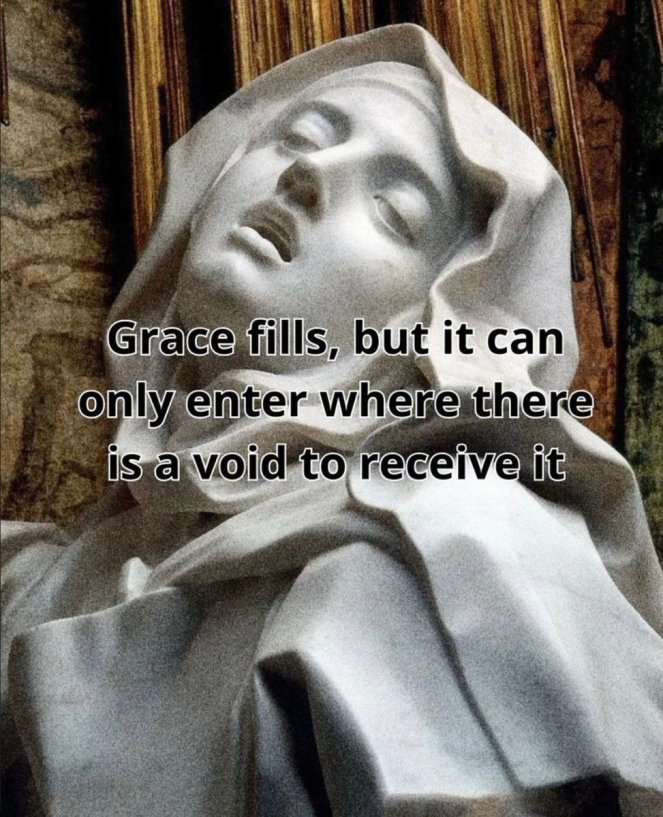
You have to let go – yes – but of the self itself, not just its attachments. I’ve been doing it ‘wrong’ for years, or rather, just not going deep enough in the letting go. In a sense, you have to be willing to die in order to break through the impasse. This is the way the ego sees it but it’s really an illusion. Nothing dies except your illusions.
“Hisamatsu likens the liberated self to a spider who spins its web without ever being caught in it.”
You play in the illusion. It’s not enough to just have the occasional breakthrough and then go back to your normal ordinary mind, unliberated. Hisamatsu says,
“So long as the root-source, ultimate suffering is not broken through, we will be eternally unable to be freed from our suffering.”
Once broken through, the Self that is realised is the same in all religions. He says the Hindus call it Self and the Buddhists non-self, but “that is a scholar’s difference.” The Self or nonself is nondual awareness where there’s no separation between the subject and object in absolute subjectivity. And no, that isn’t solipsism because it’s not the ego. The ordinary ‘I’ of the ego is opposed to all other selves.
Zen says, “At the root of the Great Doubt lies the Great Awakening” where he says,
“The dead-locked ‘I’, at the extremity of its unbearability…no longer can bear the weight of itself and breaks up.”
I haven’t broken through fully yet because I keep distracting myself from the pain of the unbearability of existence, for obvious reasons. It’s easily done these days as there’s so many ways to distract yourself. But the consequence of this avoidance is making me ill and crazy and I can’t stand it anymore. The distractions no longer work.
That’s where my notes end. I wrote them in September 2023 and five months later was plunged into a purgatorial nightmare thanks to Pluto squaring my natal Jupiter in the 8th house while Neptune was opposing my Mercury Pluto conjunction also in the 8th. My long-standing avoidance finally magnetised the perfect situation to push me into the heart of the Great Doubt and hold me there.
It has become clear that I’m trying to break out of an imaginary prison and the more I push against the bars, the more real they become. I can even watch it happen in real time – watch my reactions to the ‘slings and arrows of outrageous fortune’ make those arrows dig deeper into my own flesh. The temptation to resist is immense.
Maybe I’ll write about it at some point – once Pluto has finished shredding my faith next year – if I haven’t totally lost my mind by then!
You can read the whole essay by Steve Antinoff here: Spiritual Atheism (PDF)
Image: Owen Comics
Thanks for reading! If you enjoy this blog and would like to support my work, please donate below 🍵. Thanks in advance! 🙏❤️

 Jessica Davidson
Genius and insanity aren’t too far from each other …. I absolutely loved this post. Thank you !
LikeLiked by 1 person
Also I am guilty of this too and I think most of the human race is. I have run from myself for years and I am 39.Im just now able to even look in the mirror straight but at least I can see my reflection now and have the ability to call myself out. Next I’m working on being able to call myself out in front of other people.
LikeLiked by 1 person