
In the first part of this series we explored the technology and humanity of Battlestar Galactica, and part two covered the religious beliefs of the humans and Cylons. In this final post we delve into the nature of the gods and the cyclical view of history in the mini-series and main seasons – and as always, Expect SPOILERS!
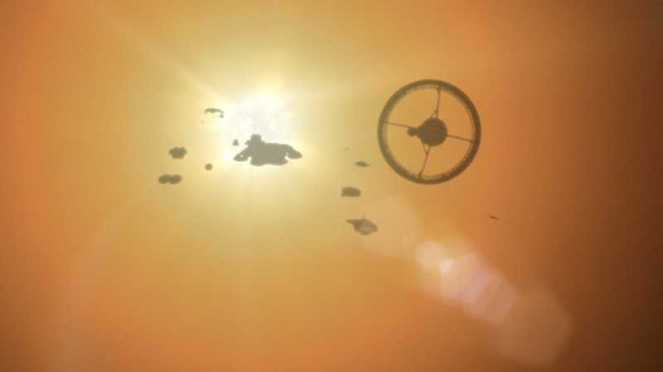
One of the interesting things about Battlestar Galactica (BSG) is its cyclical treatment of history with a great twist right at the end of the show. The general idea is that there have been cycles of wars and rebellions that repeat as each generation fails to learn the lessons of the past, whether they’re human or Cylon. And the end of the series presents us with a challenge: Will all this happen again?
In the show, the cyclical view of history comes from Pythia who wrote one of the sacred scrolls of the polytheist human religion. Pythia wrote in the past tense because she was writing about the history of humanity and the gods or Lords of Kobol. Her words are taken as prophecy but they could also just be historical. The only reason to assume that they might be prophetic is that she says history repeats:
“All of this has happened before, and all of it will happen again.”
This line is repeated throughout the show and Pythia’s words do appear to predict the events that occur. However, the scrolls may not be entirely reliable and they leave out key bits of information (like a lot of history does). It’s possible that by following the scriptures so closely they end up creating the cycles of history in a kind of self-fulfilling prophecy.
This taps into the idea of eternal return and cycles of time that repeat events in the same way over and over – a nightmare scenario to my mind. The idea may come from Pythagoras but it was associated mainly with the Stoics of ancient Greece. We also find repeating ages and cycles in astrology and the Yugas in Hinduism, as well as many other cultures, but without the exact repetition of events.
The Book of Pythia tells the story of the exile and rebirth of humanity, and BSG refers to several cycles of exodus and resettlement in a new home. The first fall and loss of paradise happened when the humans left Kobol, and a second fall occurs when the Cylons attack the Colonies at the start of the series. But there could be another cycle (or more) prior to this, hinted at in the first line of the scriptures:
“Life here began out there.”
This suggests that life didn’t begin on Kobol but started somewhere out in the wilds of space, as in the theory of panspermia. Life may have arrived on the planet by accident or was seeded by other beings, like in the film Prometheus. However it happened, it implies that the cycle of life that began on Kobol wasn’t the first, and it raises certain questions: Did humanity start on Kobol or elsewhere? Where did the Lords of Kobol come from and who (or what) are they?
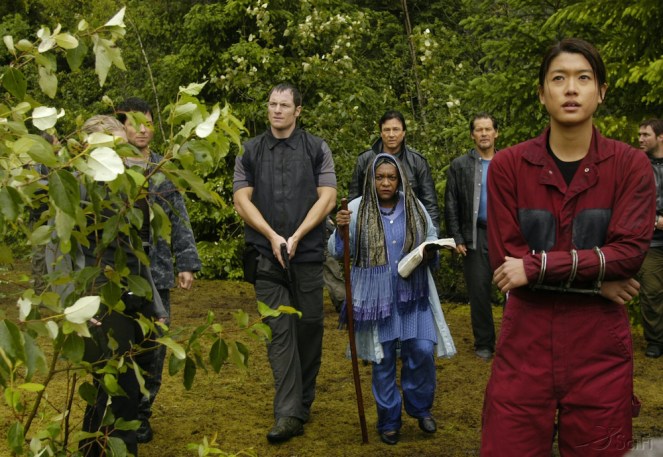
In season 2 episode 7, Sharon (Number Eight) reveals a possible clue to the nature of the gods. The humans have returned to Kobol to find the directions to Earth using the Arrow of Apollo and Sharon helps them to find the Temple of Athena. While they’re searching, Sharon calls the Lords of Kobol false idols and says she knows more about their religion than they do. When she mentions Athena, she adds:
“whoever or whatever she was.”
Considering what we discover later about the 13th tribe, it’s possible that the Lords of Kobol were engineered beings like the Cylons. Perhaps they’re the survivors of the previous cycle – the previous exile and rebirth – and the humans came to worship them as gods. This is reinforced when we discover what happened to Athena.
The scriptures say that Kobol was the birthplace of mankind where humans lived with the gods in paradise until the exodus of the 13 tribes. But it doesn’t mention that the 13th tribe was created by the humans as an artificial race of Cylon robots using resurrection technology. The Cylons rebelled and started a war and then left Kobol to find their own home – Earth.
Later the humans also decided to leave Kobol and this upset the goddess Athena so much that she threw herself off a mountain and died. The tribal leaders were buried with Athena in her tomb and Zeus warned that if the humans ever returned to Kobol it “would exact a price in blood.” So the gods weren’t immortal and they were pretty cross with the humans. (I smell a Cylon!)
This raises another question: Where are the Lords of Kobol now? Are they still hanging out on Kobol or did they wither and die when the humans left them? Is that why they don’t answer prayers?
Anyway, the humans left Kobol and founded the Twelve Colonies where they created Cylon Centurions to do their dirty work. Inevitably, the Cylons rebelled and started the war which ended with an armistice 40 years before the start of BSG. At that point, the Cylons left the Colonies for their own world, called the Colony, with their new best friends the Final Five.
To find out who they are, we need to go back in time to the previous cycle thousands of years ago.
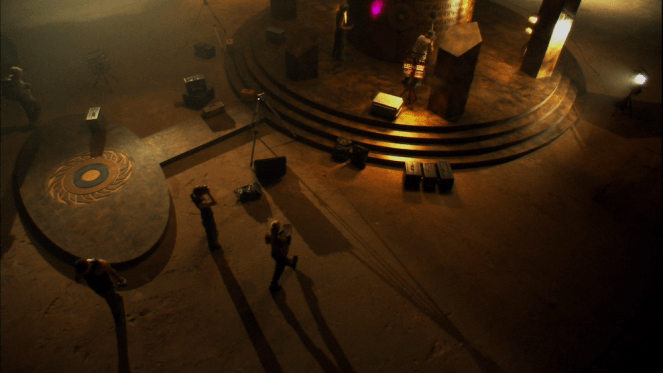
The 13th tribe of Cylons left Kobol 4000 years ago, 400 years before Pythia wrote her scriptures. On their way to Earth they built the Temple of Five, also called the Temple of Hopes, to mark the route to their new home. Pythia described it like this:
“Five pillars of the temple were fashioned after the five priests devoted to the one whose name cannot be spoken.”
This may be a reference to the One God and could be a clue to the nature of the war that drove the tribes apart on Kobol. Perhaps it was a religious war between believers in the Lords of Kobol and those of the One God. However, the 13th tribe also appears to have been polytheistic because they had their own Temple of Aurora on Earth – so perhaps not.
Whatever they believed, the 13th tribe settled on Earth and eventually evolved the ability to reproduce sexually and their resurrection technology fell out of use. They also created their own robots – but of course! – and about 2000 years before the start of BSG, the robots rebelled and the planet was nuked.
The Final Five were the scientists who reinvented the resurrection technology on Earth. They were warned about the coming war by visions of people – Messengers or Angels of the One God – who told them what was about to happen so they were able to survive. They wanted to warn the other 12 tribes about the dangers of creating artificial life and tell them to treat it well – so it doesn’t rebel and kill you!
So the Final Five set off back to the Colonies but by the time they arrived (without faster-than-light travel) it was too late – the Colonies were already at war with the Centurion Cylons. The Centurions were also experimenting with making flesh bodies and had created the Hybrids but nothing that lived on its own. The Final Five made a deal with the Centurions: stop the war and we’ll give you resurrection technology, and then went on to create the 8 humanoid Cylon models.
Who then rebelled – surprise! – and broke the armistice, starting another war.
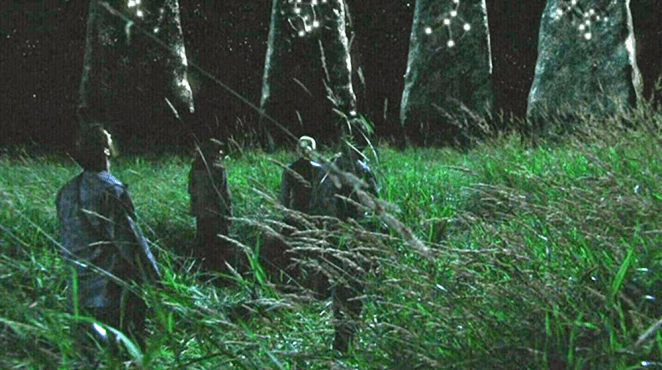
The humans arrive on Earth by following the map revealed on Kobol inside the Tomb of Athena. The tomb contains the broken statues of the 12 icons of the 12 Colonies. When they place the Arrow of Apollo into the hand of the Sagittaron statue it triggers a vision of 12 stones in a circle marked with glowing jewels in the shape of the constellations of the zodiac.
They realise that the centre of the circle represents Earth and to find it they need to follow the Lagoon nebula in the Scorpio constellation. In real life, this nebula is in the Sagittarius constellation – a mistake admitted by the writers of the show. But there’s a bigger mistake here:
Earth is found by locating the 12 constellations of the zodiac as revealed in the vision on Kobol. But why would the 12 tribes be named after these constellations if they’re found in a totally different star system? It’s all backwards! The 12 tribes are named after constellations that weren’t discovered until the 13th tribe found Earth thousands of years later. The scriptures say that:
“they looked up into the heavens and saw their twelve brothers.”
Not only that but when they discover a new Earth at the end of the show (our Earth) it also has the same constellations. What are the odds?!
Turns out this is another mistake in the writing – a problem with continuity and failing to keep track of the details. It also doesn’t matter because both Earths are actually found by Starbuck.
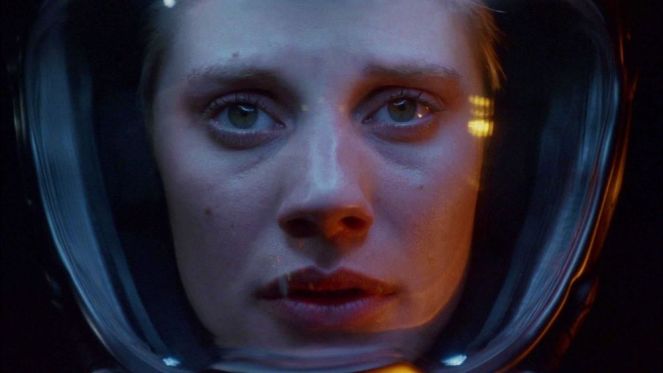
Kara Thrace (Starbuck is her viper callsign) is a brilliant but insubordinate pilot who has a special mission according to a Hybrid prophecy that says:
“Kara Thrace will lead the human race to its end. She is the herald of the Apocalypse, the harbinger of death.”
In season 3, she disappears while chasing a Raider that nobody else can see and her viper explodes. Everyone assumes that she’s dead. But a few episodes later, she reappears saying she knows the way to Earth. She struggles to understand who she is and says things don’t feel the same, like nothing can touch her. In a vision, her Angel Leoben says what he sees is:
“an angel blazing with the light of God. An angel eager to lead her people home.”
She’s able to guide them to Earth and fulfil the prophecy by following a signal emitted by her viper and they arrive to find the planet is long dead. Starbuck also discovers the remains of her own body on the planet where she apparently crashed her viper. How could she have come back from the dead? Is she really an angel?
It’s possible that she’s an angel version of Aurora, one of the Lords of Kobol, because before Starbuck disappeared, she gave a figurine of Aurora to Adama for his model ship. Aurora is the goddess of the dawn who brings “a fair wind and a fresh start”. But there’s no fresh start to be found on the dead Earth so how can Starbuck be Aurora?
Well, she may have fulfilled the prophecy but her mission isn’t over. She now needs to guide humanity to their destiny and a new home. This can’t happen until they’re all thoroughly disillusioned and ready to give up hope.

The dark night of the soul that descends when they discover the devastation on Earth triggers a loss of faith and a questioning of authority. People are fed up with following orders and authority that has led them nowhere. Disillusionment and revolution explode into mutiny and then even the Galactica itself starts to physically break apart. They’ve come to the end of the road.
Surrounded by chaos and fighting, Starbuck takes a leap of faith and punches a set of coordinates into the navigation computer. Miraculously, it brings them to a new planet – out of the darkness and into a new dawn.
The coordinates come from a series of musical notes that Starbuck translates from a drawing of stars by Hera, the human-Cylon hybrid child. This may seem arbitrary but it suggests the idea of the Music of the Spheres which states that the movement of the planets has a kind of harmony. The idea is first found in Pythagoras’ work and was later picked up by Kepler. Starbuck is able to tune in to the hidden patterns of order that reveal the divine orchestration of life in the universe and bring her people home.

The fleet arrives on the new planet and discovers primitive tribes whose DNA is compatible with theirs. The odds against human beings spontaneously evolving on another planet a million light years from theirs are astronomical, and as Gaius Baltar says:
“One might even say there was a divine hand at work.”
Adama names the new planet Earth and they decide to spread themselves around the various continents so they can start again. Some of the Cylons also decide to stay but they give the baseship to the Centurions so they can find their own destiny because they’ve earned their freedom. They jump away from the Earth and promise to be good – a risky move but will it be enough to break the cycle of violence?
Lee Adama says they can break the cycle if they leave behind all their technology and start again from scratch. His father demonstrates his colonialist tendencies by assuming the tribal people on the planet have no language or culture of their own (a bad start). Lee says they can share the best part of themselves – not the ships, technology and weapons, saying:
“If there’s one thing that we should’ve learned, it’s that our brains have always outraced our hearts. Our science charges ahead. Our souls lag behind. Let’s start anew.”
They send the Galactica and all the remaining ships into the sun to be destroyed and then settle in to disrupt the future evolution of the planet with their ‘best’ ideas and their DNA.
This is an example of the ancient aliens/astronaut idea that says visitors from elsewhere came to Earth and either fiddled with our DNA or influenced our development through the ideas of religion and culture. Much of this involves misinterpretations of incomplete ancient texts and the tendency to take creation myths literally. But there are some interesting parallels.
In Sumerian mythology the Anunnaki were the descendants of An, god of the sky, and Ki, goddess of the earth, and included beings like Enlil, Enki, and Inanna, who oversaw the fate of humanity. Later a new generation of gods appeared called the Igigi who served the Anunnaki until they rebelled and were replaced with humans who were created to do the work.
Sumerian myth also includes the Abgal, or Seven Sages, demi-gods who arrived after a flood and taught mankind the arts of civilisation. There are many similar myths of ‘Shining Ones’ from around the world, such as the Tuatha De Danann who arrived in Ireland on clouds and brought magical items with them. In Hindu mythology there are flying palaces called Vimana which were used by the gods to get around. The Book of Genesis in the Bible refers to the Nephilim, giants or fallen angels who had children with the daughters of humans and taught them various arts.
In BSG a fantastic final twist reveals that the new planet is our Earth 150,000 years ago and Hera has become mitochondrial Eve:
So according to Angel Six and Angel Baltar the cycle could be repeating once again as they observe the commercialism, decadence and technology of New York City. But will the current crop of humans make the same mistakes as the past? Angel Six feels positive about the odds but her mention of complex systems and laws of averages is unexpected, and then Angel Baltar refers to God as ‘it.’
This could suggest that the One God is some kind of machine consciousness that runs the entire universe, or even that the whole thing is a simulation. That would be a shame because it’s a stupid idea, as we’ll see. It appears to undercut the mysticism of the series, a nasty little materialist ‘rug pull’ right at the end.
But it could also just be a reference to the sacred mathematics that underpins life and the whole universe – God is the ultimate mathematician, after all. And Baltar saying that God doesn’t like that name refers to God not being nameable.
As to the Cylon God being a machine – it’s not actually possible. There couldn’t be a machine that knows everything in the universe because it would have to be self-referential and Gödel’s incompleteness theorem makes that impossible. Life is ambiguous and transcendent so it can’t be programmed or simplified into mathematics or machine language.
Meaning is fundamental to the way the mind or consciousness works, and this would also be impossible to programme – and is why AI is stupid. So we don’t need to worry about sentient robots like the Cylons. All this won’t happen again, and in fact, it could never happen!
Battlestar Galactica is clearly a warning to be careful about the technology we create and to not look to our technology to answer the ultimate questions about existence. The danger isn’t that the robots will become self-aware and rise up and kill us all. The real danger is that we become more like robots rather than robots becoming more like us– and that’s already happening.
The answer according to Battlestar Galactica is love – to embrace our humanity and the connections between people and build a better future together.
Explore more films here
Thanks for reading! If you’d like to support my work, please donate below 🍵. Thanks in advance! 🙏❤️

 Jessica Davidson
reminds me of a novel i’ve just read, by j winterson. ”the stone gods”.
LikeLike
Looks like an interesting book.
LikeLiked by 1 person
it is, though she does seem somewhat taken in by the whole thing just now. or not. idk. i’m trying to read 21 bytes.
LikeLike