
Venus represents the principle of attraction and relationship and shows what you value and desire, how you relate to others and attract people or things into your life. She may be the planet of love and beauty but she also has a dark side, especially when she feels disrespected or overlooked, and can even be found starting wars…
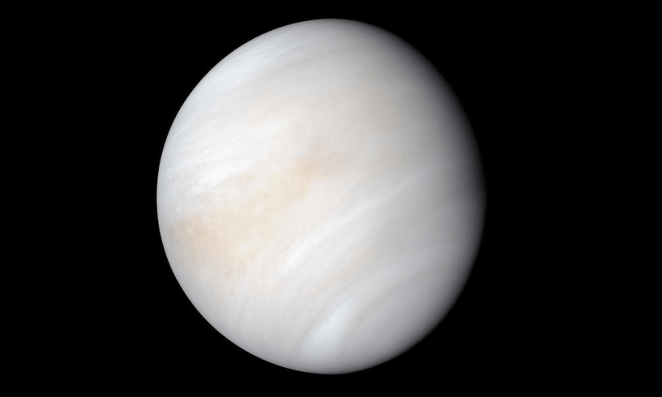
Venus takes about 225 days to orbit the entire zodiac and spends about 3 weeks or more in each sign depending on where she is in her cycle. She goes retrograde roughly every 18 months when she can spend several months in one sign. Venus orbits between the Earth and the Sun so is always within about 47 degrees of the Sun and never more than 2 signs away in the horoscope.
The Venus cycle traces a 5-pointed star in a ratio of 13:8 which means there are 8 Earth orbits to 13 Venus orbits with a synodic period of about 584 days. The start of this cycle is measured from the inferior conjunction between Venus and the Sun and the pattern shifts backwards through the zodiac, repeating every 8 years. More on this here: The Venus Cycle, Phi and the Venus Star
During her cycle, Venus appears as either a morning or evening star. As the morning star, she’s called Phosphorus or Lucifer, meaning ‘light-bringer’, and as the evening star she becomes Hesperus, meaning western. This reveals her dual nature, with the morning star seen as masculine and the evening star as feminine.
Venus rules both Taurus and Libra and is exulted in Pisces. The glyph is the circle of spirit over the cross of matter, similar to the ankh in Egyptian mythology which symbolises life or the soul. It also represents the element of copper in alchemy and may resemble a mirror as used by the goddess.
Venus is a feminine planet but this has nothing to do with biological sex, despite the glyph being used to symbolise the female sex and femininity. Everybody has Venus in their horoscope and the planet rules the feminine Taurus and masculine Libra. It represents the feminine side of the psyche or the yin principle.
Venus is sometimes described as the Lesser Benefic or Lesser Fortune due to her reputation for bestowing beauty, charm and the objects of your desire. As the lower octave of Neptune, Venus represents personal love and values, while Neptune represents universal love that transcends the individual desire nature.
Some archetypes associated with Venus include: the Lover or Beloved, the Great Harlot, the Femme Fatale, the Anima, the Artist, the Beautician, the Poet, the Diplomat, and the Bitch. Let’s see how all this is portrayed in the myths…
Venus Myths
Most cultures associated Venus with a goddess of love and war to reflect her dual nature, but many Mesoamerican cultures saw Venus as male. The Aztecs saw the planet as Quetzalcoatl, a feathered serpent who becomes Venus after a complicated tale involving vanity and seduction leading to a fall from grace and eventual transformation into the planet. Quetzalcoatl was linked to the morning star, while his twin brother Xolotl was the evening star.
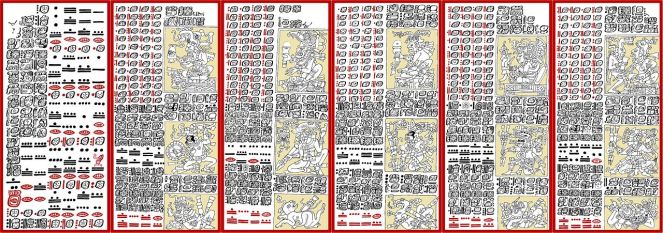
The Mayan version was known as Kulkulkan, another feathered serpent, but Venus was also called Chak Ek’, meaning Red Star, and was associated with war. The Maya used Venus to calculate their Long Count calendar, as found in the Dresden Codex which includes another complicated tale about Venus and the Sun.
Chak Ek’ is the morning star who battles his brother, the Sun, known as K’in Ahaw. The problems start when K’in Ahaw outshines his brother so Chak Ek’ descends into the underworld to plot against him. When he returns, he causes chaos and goes around attacking the other gods. Watch the whole mad tale here.
These tales describe the cycle of Venus as the planet appears and disappears in relation to the Sun. To the Maya and many other cultures, the most dangerous time during this cycle was the inferior conjunction when Venus is retrograde, as well as the first appearance of the morning star. These times do tend to correlate with key events in history, as Bruce Scofield explores in this excellent article: Quetzalcoatl and the Sexual Secrets of the Toltec Astrologers
Meanwhile in Sumer, Venus was associated with Inanna, the goddess of love, war and fertility, who was one of the most popular deities in their pantheon, dating back to 4000 BCE. As Queen of Heaven, she was patron of the arts and of battle and was often depicted with a lion, a symbol of power. She was also symbolised as an 8-pointed star which relates to the 8-year cycle of Venus, and her twin brother was Utu (or Shamash), the Sun god.
Inanna was known as Ishtar to the Babylonians and Assyrians, and Inanna-Ishtar became syncretised, although they were separate deities originally. Ishtar influenced the Phoenician Astarte, goddess of war, beauty and love, who then went on to influence the Greek Aphrodite.
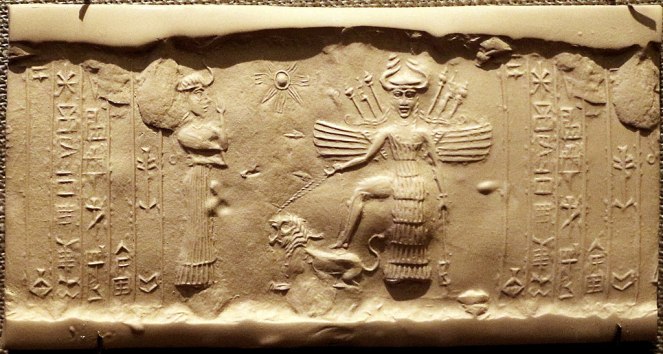
Inanna was married to Dumuzid, god of shepherds and fertility, and there are many hymns and passionate love poems dedicated to their courtship. Her worship included a ritual of sacred marriage where the goddess bestowed her blessing onto the king. It’s not clear whether these sexual rites were performed literally or symbolically. Either way, by uniting with the goddess, the king was given the power to ensure the fertility of the land. More on this in Aries Myths.
Inanna is a force of nature and a source of creative power, endlessly fertile, fierce and independent and always going on conquests to get more power for herself. She rampages around, shagging whoever she wants and dealing harshly with anyone who disrespects her. Battles were called the Dance of Inanna and she’s described as:
“Lady of blazing domination, clad in dread. Riding on fire-red power. Flood, storm, hurricane adorned. Battle planner, foe smasher.”
In one of her quests, Inanna descends into the underworld which belongs to her sister, Ereshkigal, and attempts to take it by force. She wants to claim power over the dead, but as she descends, she’s stripped of all her finery and hung on a meat hook to rot. After a few days, Inanna is rescued and returned to life but somebody else has to take her place and she allows Dumuzid to be dragged away by demons.
Dumuzid ends up sharing his time in the underworld with his sister, Geshtinanna, and they take it in turns to spend half the year down there, giving rise to the seasons. This is similar to the story of the abduction of Persephone in Greek mythology but with the goddess playing a more active role.
As with the Mesoamerican myths, The Descent of Inanna relates to the cycle of Venus and mirrors the way the planet disappears from view during its dance with the Sun. To the Assyrians, Ishtar also appeared to change gender as she moved through her cycle.
The Assyrians saw the evening star as the feminine love side of Ishtar, while the morning star was the warrior side of the goddess who was sometimes depicted with a beard. The name Ishtar is actually masculine and one text compares her to Ashur, the national god of the Assyrians:
“Like Ashur she wears a beard and is clothed with brilliance…”
However, the word for beard can also be translated as ‘to shine’ or ‘bright’, so it may just be a metaphor for the brightness of Venus in the sky. Despite the masculine form of Ishtar’s name, there’s no doubt that Inanna and Ishtar are defiantly female and the bearded references are rare. But of course, it’s not that simple and there are other bearded goddesses, as we’ll see.
Inanna was a champion of androgyny and her temple priests, or gala, were men who dressed as women and sang in female styles and dialects, although some of them were women. In the Babylonian Epic of Erra, the priests are supernaturally transformed from men into women by Ishtar. And A Hymn to Inanna written by the high priestess, Enheduanna, says:
“To destroy, to build up, to tear out and to settle are yours, Inanna. To turn a man into a woman and a woman into a man are yours, Inanna.”
There are many similar passages but it’s not clear whether the male priests castrated themselves or were eunuchs, like the priests of mother goddesses such as Cybele, who were called galli. It may be that these androgynous qualities are echoes of a more ancient goddess.

Fertility goddesses like Inanna have deep roots that go back into pre-patriarchal cultures that honoured the cycles of nature through Great Mother goddesses who represented both life and death. These goddesses were self-sufficient and self-fertilising – female but also phallic.
In Cancer Myths, we explored these mother goddesses in the so-called Venus figures that date from c. 40,000 BCE and have exaggerated female characteristics representing an endless source of life and fertility. Coming forward in time, we find more androgynous fertility goddesses, especially in Cyprus where there are sculptures dating back 6000 years.
Some of these goddesses have beards, while others have wide hips and breasts but also long phallic necks, like the Lady of Lemba in the image above, found near Paphos in Cyprus. Marie-Louise Winbladh explores the evidence for the Bearded Goddess in her book of the same name and shows how these goddesses eventually evolved into Aphrodite.
The earliest form of Aphrodite may have been a hermaphrodite version called Aphroditus who originated from Amathus in Cyprus and was associated with the moon. The name is masculine in form but Aphroditus was depicted as a woman with a beard and is often shown lifting her dress to reveal her phallus. She/he was worshipped in rites where men and women exchanged clothes.
Over time, the fully feminine version of Aphrodite grew to become more popular but the idea of the hermaphrodite is still found in one of her offspring with Hermes, the two-sexed Hermaphroditus. Fast forward to Rome where the goddess was given the masculine name of Venus, and there’s also a bearded version called Venus Barbata, one of her many epithets used by the Romans.
But the strangest representation of Aphrodite is found at her sanctuary at Paphos where she was worshipped as a mysterious lump of volcanic rock. The smooth conical stone was originally painted white and is a baetyl, or sacred stone with obscure origins. It reveals Aphrodite as truly ancient and primal and rooted in the earth.

In Greek mythology, Aphrodite was the goddess of love, beauty and the arts, and like Inanna, was also a fertility and battle goddess. She was born as the result of a violent act that reinforces her ancient origins predating the Olympian gods. According to Hesiod, Kronos castrated his father Ouranos and threw his genitals into the sea and out popped Aphrodite from the sea-foam. The Erinyes, goddesses of vengeance, were also created when blood from the wound fell onto the earth.
Aphrodite has her own version of vengeance and her presence is often disruptive. Her symbols include the pomegranate with its many seeds representing fecundity, as well as doves, roses, seashells, the hand mirror and the golden apple. She also has a magic girdle that drives people wild with desire, made by her husband, Hephaistos, the divine smith (see Taurus Myths).
In other stories, Aphrodite was married to Ares, the god of war (see Aries Myths), but she was constantly unfaithful to both of them. Aphrodite seduces whoever she fancies and causes endless problems in the process. She can be cruel, jealous, vindictive and destructive, and even stirs up unnatural passions in those who disrespect her or divine laws.
When King Minos tried to cheat Poseidon out of his best bull by sacrificing a crappy substitute, Aphrodite took revenge. She drove Minos’ wife, Pasiphae, mad with passion for the bull, enough to mate with it (don’t ask 😳), producing the Minotaur, a monster that roams a labyrinth and feeds on virgin flesh.
Aphrodite became the victim of her own scheming when she fell in love with the mortal Adonis. This story is roughly equivalent to The Descent of Inanna in Babylonian mythology with Adonis in the role of Dumuzid.
Adonis was the son of Myrrha, a woman who bragged that her daughter was more beautiful than Aphrodite, who promptly cursed her with a great passion for her own father – and the result was Adonis. He was sent to live in the underworld with Persephone and shared his time between her and Aphrodite. But then he was gored by a wild boar while out hunting and died in Aphrodite’s arms and she was heartbroken.
Since Aphrodite was born without a mother, she’s not maternal but she does have plenty of offspring, including Eros who was fathered by Ares. Eros was a god of love who fired arrows of desire at the hapless victims of Aphrodite. The Romans called him Cupid and he was often depicted as a fat cherub with a bow and arrow, but like Aphrodite, his origins are also ancient.
Originally, Eros was a creator god, a primal generative force present from the beginning of time, whose passion created the universe – love as a fundamental law of creation. In this form he was known as Phanes in the Orphic tradition and he existed even before the Titans like Kronos came into being.

The Meaning of Venus
As the planet of desire, Venus is at the heart of almost everything you do and helps you to define your values and feelings about life. By exploring your desires you discover what matters to you: your preferences, the things and people that you love, what brings you joy and pleasure, and what you find beautiful.
You value these things because they make you feel more like yourself. They reflect who you are – or they should, if you’re in touch with your Venus as an expression of your deepest soul values. You can learn about yourself by exploring what you find beautiful or valuable but this process can be heart-breaking as well as enjoyable.
Venus represents the forces of attraction but this also implies repulsion because you have to choose what you value and reject what you don’t want. You must choose guided by what you value most highly, and inevitably, this will create conflict – within yourself and with others. It forces you to think and make judgements because you can’t just blindly follow your instincts – unless you want to get into trouble.
This is reflected in the dual nature of Venus as morning and evening star, and as ruler of both Taurus and Libra. The morning star is yang or dynamic and active, like the Libran Venus which is sociable and motivated by principles and ideals. The evening star is yin or receptive and instinctual, like the Taurean Venus which is sensual and motivated by desire and bodily appetites.
It’s the Libran side of Venus that reflects your conscious choice in how to relate to others and create harmony, diplomacy and justice. It allows you to appreciate the aesthetics of beauty and the arts, as well as the refined side of relationships (as opposed to the sweaty side!), the courtship and art of love.
Even the Taurus side of Venus involves choice, although this may happen on a more instinctual level. You may not know why you like something – it just feels good.
But you can have too much of a good thing and Venus can easily lead you astray. If your values aren’t aligned with your instincts, you’re more likely to be taken over by sudden lusts and strange desires that transgress social morals or upset the people you love the most. As Liz Greene says in The Inner Planets:
“Wherever you find Aphrodite active and amusing herself, you will usually find somebody in a dreadful emotional mess. Yet if we view her with less dogmatic eyes, we can see that she is the great affirmer of the individual, by challenging the collective interpretation of ‘right’ relationship with the emotive issue of individual values.”
Your true values are often revealed when things go wrong in relationships and you find yourself embroiled in affairs and broken hearts and loneliness and longing. But you can’t avoid making a choice if you want to be true to yourself as an individual (see the Lovers tarot card).
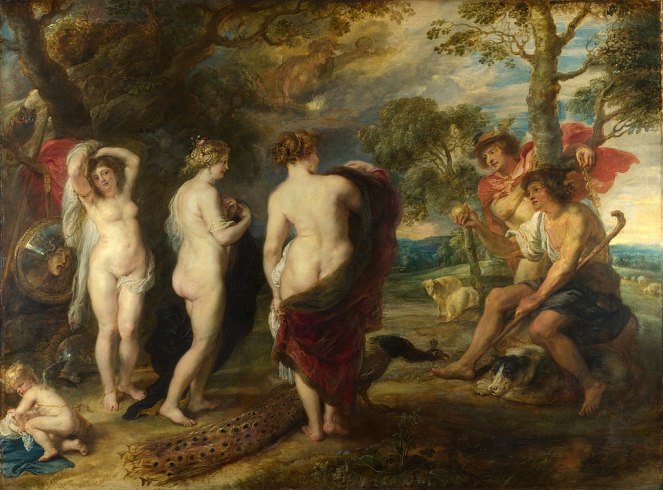
There’s no guarantee that your choice will lead to happiness, as the myth of the Judgement of Paris shows. Paris was a young man who got mixed up in an argument between three goddesses – Hera, Athene and Aphrodite – and had to choose which one was the fairest and give them a golden apple.
Each goddess offered him something in return for choosing her. Hera offered power, Athene offered victory in battle, and Aphrodite offered the most beautiful woman in the world as his wife, i.e. Helen of Troy, who happened to be married to somebody else.
Paris didn’t value power or victory in battle. He valued love and gave the apple to Aphrodite. And so the Trojan War began, during which Paris and his three sons born to Helen were killed. Helen survived and returned to her husband.
To be fair to Aphrodite, it wasn’t really her fault. The whole saga was set in motion by Eris, goddess of discord, who turned up to the wedding of Peleus and Thetis and threw the golden apple on which was written, “For the fairest one.” And so the argument began and the tragedy unfolded.
Could Paris have avoided his fate if he had made a different choice? It’s unlikely.
Denying what you value causes suffering too and leads to low self-worth, loss of joy and pleasure in life, and feelings of being ugly or unlovable. Insecurity in these areas can also bring out the dark side of Venus with jealousy, vanity and narcissism compensating for a fragile ego that needs attention because it feels unloved.
A healthy and happy Venus allows you to accept yourself as you are, regardless of what anyone else thinks. Aphrodite and Inanna don’t need the approval of others because they have total confidence in themselves and their inherent value. This kind of self-acceptance is highly attractive and it makes you beautiful – the kind of beauty that shines from the depths of your soul.
At best, Venus is the love that is Good, True and Beautiful, the love that creates worlds and civilisations and souls. She is the force of attraction and relationship, not just between people but between all created things and reflects the interconnected nature of reality – the life force that harmonises and unites the opposites. As Plato said:
“…love is the desire of the whole and the pursuit of the whole is called love.”
Venus Myths on Film
You’re spoilt for choice for films about Venus because Hollywood loves sex and romance. Films that represent the Venus archetype include stories about love, desire, romance, sex and relationships, as well as beauty, aesthetics, art and creativity. You’ll have your own favourites, but here are a few examples of Venus on film:
- Susan pursuing David with a little help from her leopard in Bringing Up Baby. (One of my all-time favourite films!)
- Musicians Joe and Jerry escaping the mob and finding love by cross-dressing in Some Like it Hot.
- William writing Romeo and Juliet and finding love with his leading lady Viola who pretends to be a boy in Shakespeare in Love.
- Actor Michael Dorsey becoming Dorothy to get a job and discovering new dimensions of himself in Tootsie.
- George the gangster who falls in love with prostitute Simone and helps to rescue her friend in Mona Lisa.
- Fergus the terrorist who wants to give up a life of violence and finds love in an unlikely place in The Crying Game.
- Jamal Malik winning the quiz of his life to find the love of his life in Slumdog Millionaire.
- Elderly actor Maurice who befriends his grand-niece Jessie and introduces her to the art world in Venus.
- Weatherman Phil Connors reliving the same day over and over as he tries to win the love of his colleague Rita in Groundhog Day.
Explore more Planet Myths here. More on the recurring world of Groundhog Day soon…
More on Venus
- Venus Keywords
- How to Interpret Natal Venus
- Zodiac Myths: The Story Behind Taurus
- Zodiac Myths: The Story Behind Libra
- Stuff on Venus Retrograde
Images: Planet; Codex; Inanna; Lemba; Rock; Venus; Paris
Thanks for reading! If you’d like to support my work, please donate below 🍵. Thanks in advance! 🙏❤️

 Jessica Davidson
Damn I’ve never seen Bringing up Baby – and I would watch any film with a Leopard co-star ! Youtube here i come…..
LikeLiked by 2 people
You’re in for a treat!
LikeLiked by 1 person
i love bringing up baby, and some like it hot!
LikeLiked by 1 person
They don’t make them like they used to!
LikeLiked by 1 person
very, very true.
LikeLiked by 1 person
btw, i just watched ” brief encounter” on tube, sad. based on a noel coward play. i thought that that woman is in for a dark night of thesoul, though wondered about the last thing her husband says to her at the end. about her having a bad dream, always coming back to him.
anyways, i’ve been pondering about the meaning of it.
on the surface it’s just a sad affair.
LikeLiked by 1 person
It’s a long time since I’ve seen it – very depressing movie!
LikeLike
incredibly.
LikeLike