
In the last couple of posts we explored the possibilities for Uranus in Gemini and how it could work in your natal chart. While researching these posts I ended up with so much material that I quickly became overwhelmed by the endless stream of information about technology and its effects on society and individuals. So what follows is a tiny slither of that data smog and it’s mostly – frankly – alarming. It’s also mostly about AI or Artificial Intelligence.

First, we need to clear up the confusion over what AI actually is and whether it really is intelligent. Intelligence is the ability to acquire and apply knowledge and skills, which is one of those circular definitions. Knowledge is facts, information and skills that are acquired through experience or education. This could easily apply to AI but there’s something missing.
The word ‘intelligent’ comes from the Latin for understanding. So the key to acquiring and applying knowledge is the ability to understand the meaning behind the information and that requires thinking and making value judgements. And for that you need mind or consciousness of some kind.
Therefore, the name ‘artificial intelligence’ is misleading because it doesn’t have a mind or the ability to think. AI may appear to think because it’s been programmed to use sophisticated language models to mimic intelligence but it has no idea what it’s doing. In AI is a digital parrot, Charles Hugh Smith explains:
“Hubris, the illusions of precision and mechanistic equivalence, and false logic are the unrecognised air holding the myth of AI aloft.”
AI language models can search and process information faster than a human being, which can be useful. But it’s no substitute for your own mind, assuming you know how to use it – your mind, that is.
Those who are easily fooled into seeing AI as having a mind or being sentient may struggle to fully understand what mind even is. We have a degraded understanding of consciousness thanks to scientific materialism but consciousness isn’t reductive and it’s not an emergent property of the brain. Maybe Uranus in Gemini will blast people out of this mental cul-de-sac once and for all.
It should be obvious that a machine doesn’t understand meaning because it doesn’t have a mind. But the alarming thing is, a lot of people also struggle to understand meaning because they don’t appear to really think. On his substack, Gaius Baltar explores this can of worms in an article about the reduction of consciousness in society.
He explains that many apparently intelligent people don’t seem to be able to think clearly and tend to react emotionally to everything based on assumptions and fixed ideas. They struggle with intuition and common sense, as if their minds are:
“carved in stone rather than being flexible and fertile.”
This relates to the duality of reason which involves two types of thinking: analysis and synthesis, or deductive and inductive thinking. Analysis is deductive reasoning which takes an assumption or general laws and logically infers particular examples in a linear process that follows logical rules. This is mostly a left-brain process.
Synthesis is inductive reasoning which looks for patterns in the information and infers general laws from particular examples. This isn’t linear or necessarily logical and tends to be associative and mostly a right-brain process. But what you end up with must be evaluated consciously to make sure it makes sense and is a reasonable fit for the data.
Most people tend to be better at one type of thinking or the other and that can cause problems. You can be highly intelligent and good at logical thinking with a high IQ but be hopeless at making sense of reality and have no common sense because your basic assumptions are faulty and fixed. Uranus in Gemini could encourage some to break out of these fixed patterns but it could be a painful process for them.
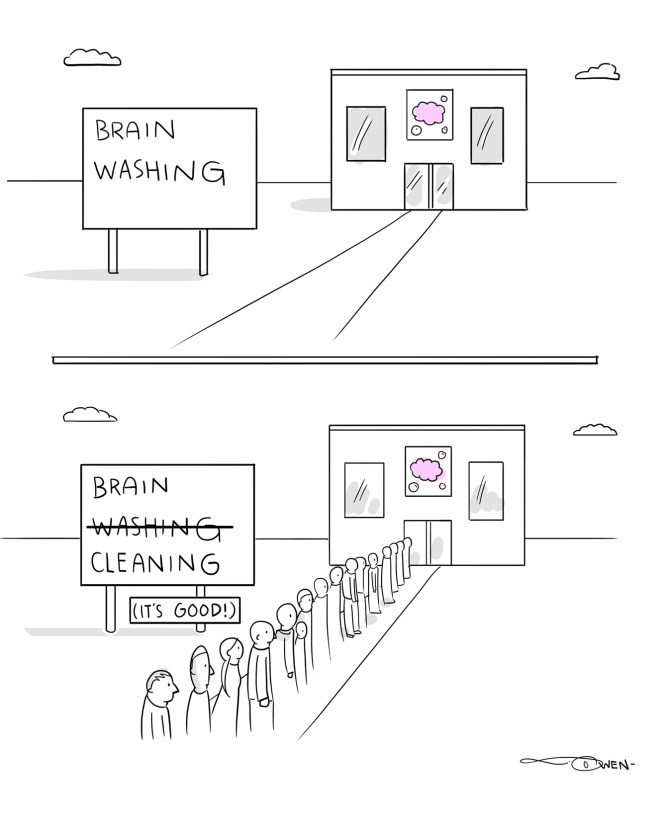
It’s not only highly intelligent people who struggle with fixed ideas and false assumptions. Recent international tests showed that the average person’s capacity to process information and use reasoning to solve problems has been declining since the mid-2010s, both in teenagers and adults. There’s been a huge decline in numeracy and literacy, as well as reading and the ability to learn new things and solve problems using creative thinking.
This may be reflected in the way the internet has changed in that time with the rise in the use of smartphones and the move away from long-form articles to short bits of text and video. And even the videos are now getting shorter. Constant distractions from notifications also fragments concentration which doesn’t help.
The key to the problem appears to be how passive this use of the internet is. Those who struggle with declining intelligence tend to be more passive and less self-directed in how they use the technology. They just accept whatever the algorithm delivers.
This decline can also be found in the education system. There are many reports coming in from teachers lamenting their students’ inability to think clearly or understand what they’re being taught. Students are using chatbots to write essays and then can’t answer basic questions about the subject they’ve been supposedly studying. Huge numbers of people don’t read books, including students who are studying to become teachers.
One study looked at the literacy levels of university students studying English and found that many were unable to read at the required level. They were asked to read the opening paragraphs of Bleak House by Dickens and describe what was happening in their own words. But the majority struggled to understand metaphor and allusion, couldn’t understand character motivations and were barely able to articulate their thoughts, such as they were.
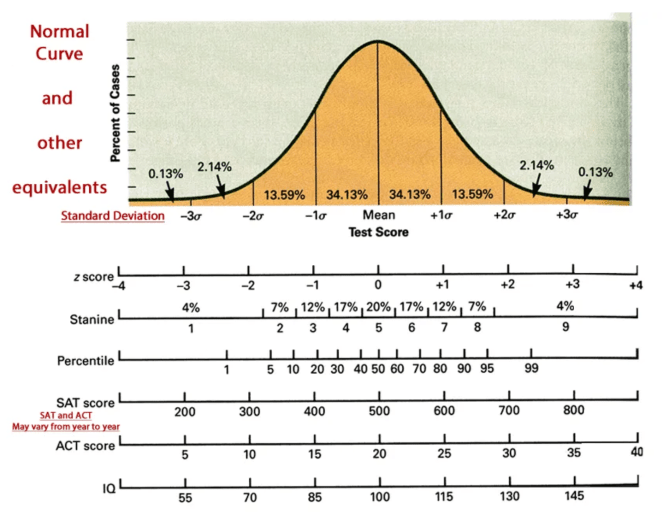
To read Dickens you need a literacy ACT score of 33–36 (level 4) which means you’re capable of reading complex prose, synthesising information and making inferences. But the subjects in the study mostly had a reading score of 22.4, which is a low-intermediate level. According to the graphs in the article (see below), the mean ACT score is 20 which relates to an average IQ of 100. So only 3% of the general population of students would be expected to pass this test.
The study commented that teachers had clearly ignored their students’ actual reading ability and assumed they would figure it out for themselves at some point – that they would teach themselves to read by reading. But this almost never happens because nobody is encouraging them to do it. Students have been completely failed by the education system (and arguably their parents) and teachers have failed to do their jobs.
It’s hard to know how representative this study is. It might have something to do with technology but it could also simply be because more people now have access to higher education who wouldn’t have previously qualified. Perhaps they would have gone to technical colleges or learned a trade or done something creative (like I did).
In another post on the Kitten substack he mentions a professor who claimed that most of his students are “functionally illiterate” because they don’t have the intellectual capacity to succeed in a college environment. Despite this, they all end up with degrees of one sort or another, and the students in the Dickens study were awarded BAs in English despite not being proficient readers.
To be fair, Dickens isn’t easy to read. The sentence construction is old-fashioned and he doesn’t half go on! I can understand him, despite not being academic, but I’m an autodidact with Mercury conjunct Pluto in Virgo and I read voraciously all the time. 📚
What this study and others show is that high mass literacy rates are not what they appear. They show that people can read and write text to a basic level, which is a useful skill. But it doesn’t necessarily translate to a deeper understanding. Perhaps they don’t develop that deeper understanding because they’re not reading the way people used to. There are too many other distractions that don’t require concentration and take less effort.

It also shows why it’s so easy for governments to lie with statistics and complex information because many simply can’t put the details together. Hence the never-ending variety of psyops that we’re subjected to on a daily basis, ranging from silly distractions to military-grade COVID and WW3 ops.
This is obviously a huge crisis and the education system is in desperate need of reform so that it works for everyone – perhaps Uranus in Gemini will help. If done the right way, the use of AI and chatbots in schools could revolutionise the way children learn and encourage more parents to educate their kids at home using these tools.
For example, I came across this tweet from Andrew Wilkinson about his 5-year-old son using ChatGPT to learn and what a great experience it was for him. The AI encouraged him and made learning fun – why can’t teachers do this? – and as he says, it never loses patience:
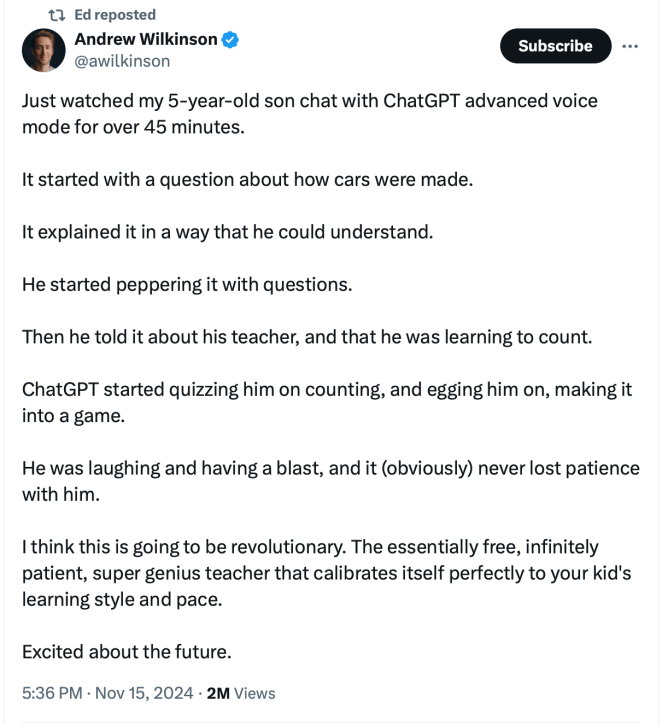
Used the right way and with careful programming, these AI tools could encourage people to read and learn and improve their skills. But used the wrong way, it could undermine your ability to think for yourself or do the work to develop your intellect. I suspect that AI works best for the young and the already smart who can think for themselves. The rest in the middle will use it as a crutch and never learn to think because they won’t have to.
A recent study from MIT looked at the effects on the brain of using AI to write essays, called Your Brain on ChatGPT. They found that 83% of ChatGPT users couldn’t quote from the essays they had written minutes earlier. Minutes! This was because they didn’t do the thinking required to create the essay and so learned nothing in the process.
The study also found a 47% reduction in brain connectivity after using LLMs compared to using your own brain to think. When they forced the ChatGPT users to write without AI, they struggled more than those who had never used it. However, using AI after you’ve already written something to enhance or rewrite your own work had better results:
“rewriting an essay using AI tools (after prior AI-free writing) engaged more extensive brain network interactions.”
It was also obvious which essays had been written using AI because of the type of language used. The teachers who marked the essays described these as “soulless” and “empty with regard to content” and lacking “personal nuances”. In other words, there was no insight or evidence of understanding of the subject covered.
This study shows that there’s nothing inherently good about AI that will make people smarter unless they choose to work with it on that level, or are encouraged to do so by a parent or teacher. You need to challenge yourself mentally in order to grow and be fully human. You can’t do that if you’re outsourcing your ‘thinking’ to a machine. But if you’re careful and use AI in a more proactive way to supplement your own thinking, then it could be a great tool.
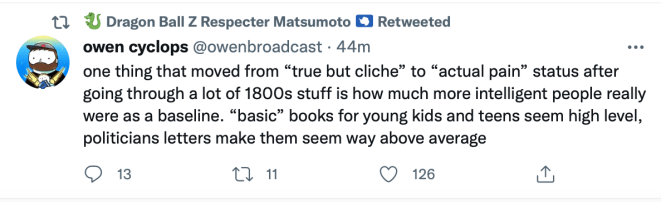
From a certain perspective it looks like technology is making us more stupid but even before AI became the latest exciting toy, people were getting dumber. The average person at the end of the 19th century had no trouble understanding Dickens and had access to a far wider vocabulary. This hilarious retelling of Three Little Pigs in the language of Shakespeare illustrates the point beautifully. Remember words?!
As he says, these days people prefer to watch the TV or film adaptation of a book because it takes less effort. Some even struggle to follow movies and don’t understand cultural references or symbolism because they have nothing to compare it with. Their view of the world has shrunk to whatever the algorithm shows them.
We don’t know what the long-term effects of using this kind of tech will be but it’s not hard to imagine. Those who are already lazy may decide it’s not worth bothering to learn anything. They can just ask AI for ‘the answer’ and appear to be smart. This may fool others for a while, but it’ll soon become obvious that you’re cheating and hiding behind the AI.
In the meantime you’re destroying your own mind and losing your ability to think and imagine and create. Your brain is malleable and constantly adapting to whatever experience you feed into it. If you don’t use your brain to think, you could lose that ability. In the end, you won’t be able to think for yourself at all.
This will ultimately make your life so much less than it could be. If you can’t think an idea through and question yourself, then you can’t articulate your thoughts and feelings and communicate clearly with others. You get stuck and unable to grow because you’re too stupid to realise there’s a problem.
This makes you less conscious and more emotionally reactive, as well as easier to control and manipulate. The perfect citizen for a totalitarian state.
Ray Bradbury warned of the dangers of dumbing people down in his novel Fahrenheit 451 where reading is banned and books are burned by fireman. But before that books had been shortened into summaries due to shrinking attention spans because people were more interested in watching films and TV. Over time they lost the ability to think and ended up destroying the culture.
It’s heartbreaking to watch people hamstring themselves while believing that they’re ‘being clever’ and embracing progress. We’re creating the zombie apocalypse.

If you define intelligence as the ability to understand, then if somebody can read but can’t understand what they’re reading, are they intelligent? Are they any different to AI which doesn’t understand either?There’s a real danger in this false equivalence that could be used to reduce people to machines and strip them of their humanity.
As people get dumber, the AI will appear smarter and many could believe that it has become sentient. There’s no danger of that actually happening. The real danger is that we lose our humanity and destroy ourselves without realising that’s what we’re doing because we’re too stupid.
To be clear: it’s not the technology that’s making us stupid. We’re already stupid. Technology acts as a mirror and amplifier. It won’t save us from ourselves.
Next time we’ll dive deeper into the Illusion of Information…
More posts on Uranus in Gemini
Images: Matrix; Brain Cleaning
Thanks for reading! If you enjoy this blog and would like to support my work, please donate below 🍵. Thanks in advance! 🙏❤️


Hi Jessica – I still have a couple of Uranus articles to catch up on BUT :
You mention the scientific materialism that I would agree has been a terrible thing for our world… it seems a necessary evolution for the Spiritual and Scientific to be reunited once again — ( and this is a time of evolution) — do upcoming aspects indicate this happening in our lifetimes? Some of us are seeing The Myth of Progress as an incorrect trajectory for us now… ( we would have a healthier quality of life to be content with where we are at and returning to a natural life where possible) and the need to restore lost reverence for Nature (and the knowledge of the Consciousness / Connectedness of all things) is becoming paramount….
I am so shocked to read that today’s kids can barely write and University students can get an actual BA in English without an ability to read and comprehend ( seriously wtf?) — i didnt get anywhere near university but like yrself read continually when I was young and despite attempts to destroy brain cells I would say I am still highly literate.. We’ve created a problem here with the technology… its gonna take careful management to rectify this . ( And we need to take those BAs back until students can cope with a book ! ) ” Hand them over you fakers”
I see intelligent people falling for the Social Engineering and division-making-psyops — yet alone the masses – we’re doomed ! There is at least fightback against the continual warmongering now and maybe this will pull the wool from many eyes as to the unsuitability of those we have so far let control society….
LikeLiked by 1 person
The collpase in the myth of progress is happening now thanks to it finally reaching the end of the road. There are lots of astrological indicators, including the shift to the air cycle of Jupiter Saturn conjunctions and the mini triangle Neptune midpoint. I covered it here: https://jessicadavidson.co.uk/2024/04/29/outer-planets-triangle-2024-28-and-the-crisis-of-modernity/ and probably in other posts too. I agree that it seems to be some kind of natural evolution, at least in terms of ‘western’ consciousness.
The state of education and the lack of thinking in the general population is so depressing. It really doesn’t look good. I don’t know where we go from here. Maybe Uranus in Gemini will shake things up for the better? We can hope!
LikeLiked by 1 person
Thanku, Yes. We can hope…..
Also: reality seems to be getting more plastic and not the objective thing I always thought it was…. Maybe like Pam Gregory ( Emperor Ming) (etc) says– we can create our reality more than we have ever suspected..
Fingers Xd in all cases
LikeLiked by 1 person
More than half a century of water fluoridation has certainly played a part in the drop in baseline intelligence. Add to that the over consumption of a popular beverage that is quite high in naturally occuring fluoride (black tea) and one has a perfect storm of reduction of the average IQ.
LikeLiked by 3 people
Good point – wasn’t aware of the fluoride in black tea though.
LikeLike
https://pmc.ncbi.nlm.nih.gov/articles/PMC9096585/
https://www.sciencedirect.com/science/article/pii/S237606052030465X
LikeLiked by 1 person
Thanks!
LikeLike
Are you in uK ? I was sure that most areas didnt have flouride in water currently and the drama was that the gov want to put it in..?
It’s insane to add a chemical to every single drink or dinner that people consume….
LikeLike
Yes, I’m in the UK but I’m in one of the areas that already has fluoride added to the water – lucky me 😫
LikeLike
Aw… Truly Blessed !! ( Lunacy isnt it)
LikeLiked by 1 person